
Overview

AI document extraction converts unstructured PDFs, scanned certificates, supplier spreadsheets, and logistics forms into structured, machine-readable data fields using a pipeline of OCR, layout-aware parsing, machine learning classifiers, and LLM-based agentic processors. For Central European brands navigating GPSR technical documentation requirements and EU Digital Product Passport obligations, DDP Grid is a practical starting point: it imports products from Shopify, CSV, or API; applies AI-assisted extraction to supplier documents; routes every extracted value through a human review and approval workflow; and publishes permanent passport pages with QR codes. Two signals matter most for regulatory use: per-field provenance coordinates that show exactly where in the source document a value was found, and a versioned audit trail that makes every extracted field traceable to its evidence.
Table of Contents
- What should you expect from modern AI document extraction platforms?
- How does a modern extraction pipeline actually work?
- How do you measure extraction accuracy before going to production?
- What do deployment and compliance look like for Central Europe?
- How do you integrate document extraction into existing systems?
- How do you plan for throughput, reliability, and operational costs?
- What do pricing models look like, and how do you scope a pilot?
- What do real Central Europe use cases look like?
- How do you select a vendor and run a productive demo?
- Key Takeaways
- Why AI document extraction matters more than most brands realize
- DDP Grid brings AI extraction and compliance workflows together
- Useful sources
- FAQ
What should you expect from modern AI document extraction platforms?
The capability gap between entry-level OCR tools and production-grade intelligent document processing platforms is wide. Before you evaluate vendors, map their feature set against this checklist.
Core capabilities to require:
- Multi-language OCR with support for at least the major EU Member State languages (German, French, Polish, Czech, Hungarian, Romanian) and handwriting recognition for legacy certificates
- Layout and table extraction that preserves row/column structure for bills of materials, chemical composition tables, and test reports
- Document classification and splitting to separate multi-document PDFs into discrete records automatically
- Field and entity extraction for named entities such as GLN, EORI, GTIN, material names, manufacturer addresses, and safety identifiers
- Confidence scores at the field level, not just document level, with a clear numeric threshold that triggers human review
- Per-field provenance coordinates that record the bounding box or page/line reference for every extracted value
- Audit trail with model version, extraction timestamp, reviewer identity, and approval status for each field
- Human-in-the-loop workflows where low-confidence or flagged values are queued for manual verification before publishing
- Output formats including JSON, CSV, XML, and GS1-compatible structures for downstream PIM, ERP, and registry submission
- Connectors for Shopify import, CSV/Excel bulk upload, and REST API for custom integrations
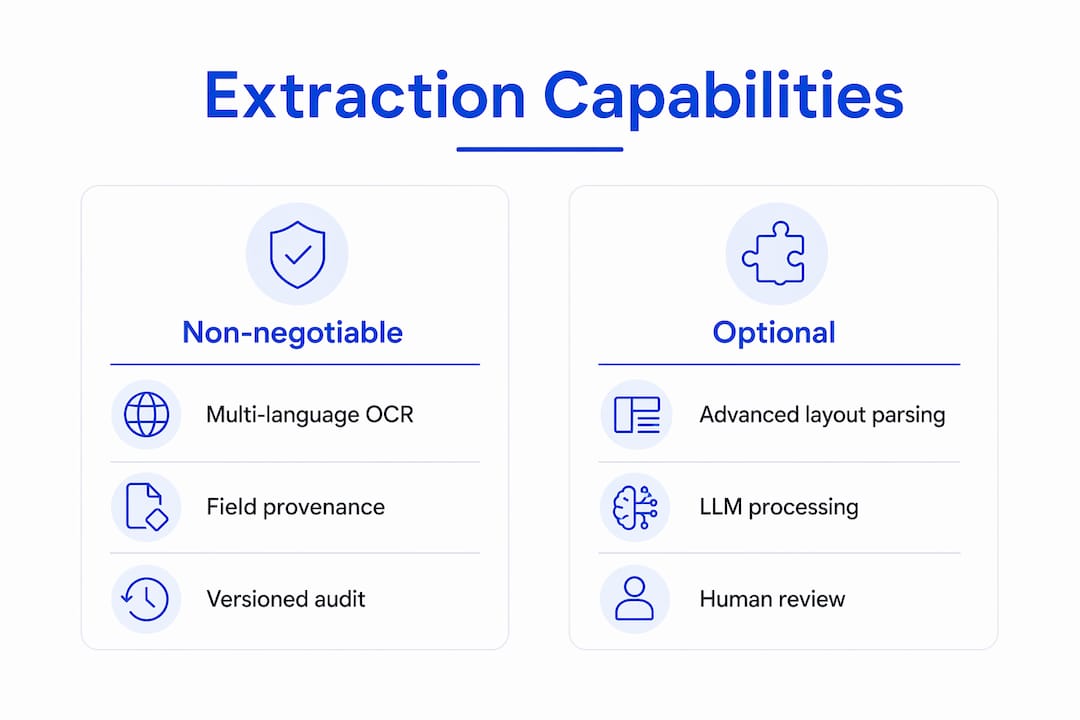
The table below maps capabilities to the use cases where they are non-negotiable versus useful-but-optional.
| Capability | DPP / GPSR | Invoice AP | Logistics | Contract |
|---|---|---|---|---|
| Multi-language OCR | Required | Required | Required | Useful |
| Table / BOM extraction | Required | Useful | Required | Useful |
| Handwriting recognition | Useful | Useful | Required | Optional |
| Per-field provenance | Required | Useful | Useful | Required |
| Audit trail | Required | Required | Useful | Required |
| GS1 / EORI entity extraction | Required | Optional | Required | Optional |
| Human-in-the-loop review | Required | Useful | Optional | Required |
For DPP and GPSR workflows specifically, multi-language recognition and machine-readable identifier extraction (GLN, EORI) are not optional. EU Regulation 2024/1781 requires DPP data to be based on open standards, machine-readable, structured, searchable, and transferable through an open interoperable exchange network without vendor lock-in. That requirement flows directly into your export format choices.
Pro Tip: Require vendors to expose per-field provenance coordinates in their API response, not just a document-level confidence score. A single aggregate score tells you nothing about which fields to trust and which to route to a reviewer.
How does a modern extraction pipeline actually work?
The architecture of a production-grade system has six distinct layers, and understanding where each layer sits helps you evaluate vendor claims and design your own pipeline.
1. Ingestion. Documents arrive via SFTP, API upload, email parsing, or direct scanner feed. At this stage you assign a document type hint (invoice, certificate, BOM, safety datasheet) and a tenant identifier that links the document to a specific supplier or SKU catalog.
2. OCR and vision layer. A vision model or classical OCR engine converts image pixels into text tokens with bounding-box coordinates. Fine-tuned vision models outperform off-the-shelf OCR on low-quality scans, rotated pages, and non-Latin scripts common in Central European supplier documents.

3. Layout parser. A layout-aware model (such as a transformer trained on document structure) reconstructs reading order, identifies table boundaries, and separates headers from body text. This layer is what makes table extraction reliable across diverse document formats.
4. ML classifiers and field extractors. Rule-based extractors handle predictable fields (invoice numbers, dates, GTINs). Learned extractors handle variable-position fields (material percentages, country of origin, recycled content). The two approaches are usually combined: rules for high-confidence anchors, ML for everything else.
5. LLM-based agentic processor and RAG. An LLM control plane interprets complex product specifications and materials lists that fall outside the training distribution of narrower models. Practitioner accounts confirm that the hardest part of compliance extraction is semantic mapping to standard EU data models such as GS1 and EPCIS, and that retrieval-augmented generation (RAG) helps align supplier PDFs and legacy spreadsheets to tenant-specific catalogs. DPP implementations often use a two-stage pipeline: keyword-based material recognition first, then RAG to fill unknown entries, with the catalog improving as more documents are processed.
6. Validation, human review, and export. Low-confidence values are flagged and routed to a human review queue. Approved values are written to the structured output with provenance, model version, and reviewer identity attached. The final payload is exported to PIM, ERP, or registry-submission formats.
A minimal JSON output for a single extracted field looks like this:
{
  "field": "recycled_content_percentage",
  "value": "42",
  "unit": "%",
  "confidence": 0.91,
  "provenance": {
    "page": 3,
    "bbox": [112, 445, 310, 462]
  },
  "model_version": "extractor-v2.4.1",
  "gs1_mapping": "cbv:recycledContent",
  "review_status": "approved",
  "reviewer_id": "user_8821",
  "approved_at": "2025-11-14T09:32:00Z"
}
That structure gives you everything you need for an audit trail: where the value came from, how confident the model was, which model version produced it, and who approved it.
How do you measure extraction accuracy before going to production?
Vendor demos run on clean, pre-selected documents. Your evaluation should not. Build a test corpus that reflects the actual documents your suppliers send.
Testing checklist:
- At least 50–100 documents spanning your full supplier base, not cherry-picked clean examples
- Language mix matching your actual supplier geography (German, Polish, Czech, and Hungarian are common in Central European supply chains)
- Noisy scans, rotated pages, and low-resolution images from legacy certificate archives
- Multi-page documents with embedded tables and BOMs
- Handwritten fields on older conformity declarations or inspection certificates
- Edge cases: password-protected PDFs, Excel exports saved as PDF, and scanned fax copies
Metrics to capture for each field type:
| Metric | What it measures | Acceptable threshold |
|---|---|---|
| Field-level precision | Extracted values that are correct | 95%+ for safety-critical fields |
| Field-level recall | Required fields successfully extracted | high for DPP-required fields |
| F1 score | Harmonic mean of precision and recall | 0.92+ for production readiness |
| Table cell accuracy | Correct cell values in BOM/composition tables | high |
| Per-field confidence distribution | Spread of confidence scores across field types | Flag fields with mean confidence below 0.80 |
| End-to-end DPP completeness | % of required DPP fields populated without manual intervention | Track per product model |
For A/B testing between two extraction models or configurations, stratify your sample across supplier types and SKU categories. A sample of 200–300 documents per stratum gives you enough signal to detect meaningful differences in F1 score. Set your acceptance threshold before you run the test, not after you see the results.
Successful implementers treat extraction output as a suggestion layer: flag low-confidence values and route them through a human review flow; store provenance and model version for every extracted value to preserve the auditability that GPSR and EU DPP obligations require.
Pro Tip: Ask vendors for a reproducible test harness you can run on your own document sample before signing a contract. If they can only show you results on their benchmark corpus, that is a red flag.
Deployment modes and data residency
Four deployment patterns are common, each with different implications for GDPR and integration complexity:
- Multi-tenant cloud (fastest to deploy, lowest cost, shared infrastructure): acceptable for most use cases when the vendor offers EU-region data residency and a signed Data Processing Agreement
- Cloud private tenancy (dedicated compute and storage within EU regions): preferred for brands processing sensitive supplier data or operating under sector-specific data rules
- Hybrid (cloud processing with on-premises data storage): useful when existing PIM or ERP systems cannot expose data to external APIs
- On-premises (full control, highest operational cost): typically reserved for large manufacturers with strict data sovereignty requirements
For most Central European fashion brands and Shopify merchants, cloud with EU-region data residency and a clear DPA is the practical choice.
GDPR considerations
Supplier data collected during extraction (contact details, facility addresses, certifications) constitutes personal data in some cases. Establish a lawful basis for processing before ingestion, apply pseudonymization where possible, and set retention schedules. Audit logs that record reviewer identities must also comply with data minimization principles.
GPSR and EU DPP requirements
Regulation (EU) 2023/988 requires manufacturers and importers to maintain comprehensive technical documentation per product model and to keep that documentation for 10 years after the product is placed on the market. EU guidance clarifies that technical documentation should be prepared for each product model, not per unit, and must include product identification, characteristics, and risk analysis. AI-assisted extraction accelerates the assembly of that dossier from supplier PDFs, test reports, and certificates.
Regulation (EU) 2024/1781 requires DPP data to be machine-readable, interoperable, and accurate, with the Commission setting up a registry to store unique identifiers and a public portal for searching passport data. QR codes help meet accessibility obligations, but EU guidance is explicit: electronic delivery does not replace the legal duty to provide accurate safety information in the appropriate language for each Member State of sale.
Compliance checklist:
- EU-region data residency confirmed in writing
- Encryption at rest (AES-256 or equivalent) and in transit (TLS 1.2+)
- Role-based access controls with audit logging
- SOC 2 Type II or ISO 27001 certification from the vendor
- Signed Data Processing Agreement covering supplier data
- Retention schedule aligned to the 10-year GPSR documentation requirement
- Export formats that meet open-standard requirements for EU registry submission
For GPSR product-safety readiness, the documentation workflow must support per-model technical dossiers, not just per-batch or per-unit records.
API flow from upload to export
A typical integration follows this sequence:
- Ingest: POST document to extraction API with document type hint, tenant ID, and idempotency key
- Process: Receive job ID; poll status endpoint or wait for webhook callback
- Retrieve: GET structured payload with per-field values, confidence scores, and provenance coordinates
- Validate: Run automated validation rules (required fields present, confidence above threshold, identifier format checks)
- Review: Route low-confidence or failed-validation fields to human review UI
- Approve: Reviewer confirms or corrects values; system writes approved record with reviewer identity and timestamp
- Export: Push approved payload to PIM, ERP, or GS1-compatible registry submission format
Connector patterns
Shopify import: Pull product catalog via Shopify Admin API, match extracted supplier data to product records by GTIN or SKU, and write enriched fields back to metafields or a connected DPP platform. DDP Grid's Shopify integration handles this import flow directly.
CSV/Excel bulk import: Map supplier column headers to your internal field schema using a configurable mapping template. Build a validation step that flags unmapped columns before ingestion to avoid silent data loss.
ERP/PIM sync: Use webhook callbacks to trigger downstream sync jobs when extraction and approval are complete. Store the extraction job ID as a foreign key in your PIM record for traceability.
Developer considerations:
- Authenticate via OAuth 2.0 or API key; prefer OAuth 2.0 for multi-tenant environments
- Implement exponential backoff on rate-limited endpoints (429 responses)
- Use idempotency keys on upload requests to prevent duplicate processing on retry
- Request sandbox access during vendor evaluation to test your actual document corpus before committing to production
How do you plan for throughput, reliability, and operational costs?
Engineering leaders often underestimate the operational complexity of running document extraction at scale. A few hundred documents per day in a pilot becomes tens of thousands during a product launch or seasonal import cycle.
Operational checklist:
- Estimate peak pages per day from your product catalog size and supplier refresh frequency
- Define separate SLAs for batch processing (overnight enrichment) and real-time processing (point-of-sale or customs queries)
- Set concurrency limits per tenant to prevent one large import from starving other jobs
- Design backpressure: queue incoming jobs when processing capacity is saturated rather than dropping them
Monitoring metrics to track in production:
- Job success rate by document type (a drop in invoice success rate often signals a supplier format change)
- Per-field confidence trends over time (degrading confidence on a specific field type signals model drift)
- Average processing latency and p95/p99 latency for SLA compliance
- Human review queue age (a growing queue means either model quality has dropped or reviewer capacity is insufficient)
- Error rates segmented by document type, language, and supplier
Reliability patterns: Implement idempotent processing so that retried jobs produce the same output. Version your extraction models and maintain a schema migration strategy so that a model update does not silently change field names or value formats in downstream systems. Keep a documented incident playbook: what to do when extraction failure rates spike, who owns the alert, and how to roll back to a previous model version.
For high-variance events like product launches or seasonal imports, design your ingestion pipeline with autoscaling and set cost controls (monthly page-processing caps or budget alerts) to avoid unexpected bills.
Common pricing structures
- Per-page pricing: A flat rate per page processed, regardless of field count. Predictable for steady-state volumes; expensive for high-page-count documents with few extractable fields.
- Per-API-call pricing: Charged per extraction request. Works well for low-volume, high-value documents (contracts, certificates) where each call returns many fields.
- Tiered monthly page volume: A monthly page allowance with overage rates. Most common for production deployments; negotiate the overage rate, not just the base tier.
- Seat licenses for human review: Some vendors charge per reviewer seat in addition to processing fees. Factor this into total cost of ownership when your review queue is large.
- One-time implementation fees: Fine-tuning a model on your document corpus, building custom connectors, or configuring a tenant catalog typically carries a one-time or project fee separate from ongoing usage.
Primary cost drivers
Beyond the headline per-page rate, the real cost drivers are model fine-tuning effort (especially for non-standard document layouts), the number of languages you need to support, storage and retention costs for audit logs, human review throughput, and any custom connector work for ERP or PIM integration.
Pilot scoping
- Define success metrics upfront: target F1 score per field type, end-to-end DPP completeness rate, and maximum human review rate
- Select a representative sample of 200–500 documents covering your full supplier and language mix
- Agree on a time-limited pilot price cap so that overruns during testing do not become a budget surprise
- Insist on an exportable data dump at contract end, in an open format, so you are not locked into a vendor's proprietary schema
- Set roll-to-production acceptance criteria before the pilot starts, not after you see the results
Digital Product Passports from supplier PDFs
A fashion brand importing textiles from Polish and Czech suppliers receives material composition certificates, test reports, and conformity declarations in multiple languages and formats. An extraction pipeline classifies each document, extracts material percentages, recycled content figures, manufacturer GLNs, and EORI numbers, maps them to the EU DPP data model, and flags low-confidence values for human review. The result is a structured, evidence-backed product record that feeds directly into a passport page with a scannable QR code. Manual hours per SKU drop from hours to minutes for the data assembly step, though human review of flagged fields remains part of the workflow.
Automated invoice extraction for accounts payable
AP teams in Central European manufacturing businesses process invoices from dozens of suppliers in German, Polish, Hungarian, and Czech. Extraction pipelines pull invoice number, date, line items, VAT identifiers, and IBAN from each document, validate against purchase order records, and route exceptions to a reviewer. The measurable benefit is faster processing cycles and fewer keying errors, not the elimination of human oversight.

Contract clause extraction for legal intake
Legal teams at importers and distributors use extraction to identify liability clauses, jurisdiction terms, and product warranty language across large contract volumes. The pipeline classifies clause types, extracts key terms, and populates a contract management system. Confidence scores are especially important here: a misclassified liability clause has real legal consequences, so human review thresholds should be set conservatively.
Logistics and shipping document parsing
Customs declarations, bills of lading, and packing lists contain structured data (HS codes, country of origin, net weight, consignee EORI) that extraction pipelines can capture reliably. For Central European importers, accurate EORI extraction is particularly valuable for customs clearance workflows.
Language and regional note: EU guidance is clear that QR codes increase accessibility to required safety information but do not remove the manufacturer's core duty to provide accurate information in the appropriate Member State language. Build language detection and tagging into your extraction pipeline from day one.
Questions to ask in every vendor demo
- Where is my data processed and stored? Can you confirm EU-region residency in writing?
- Show me the per-field provenance output for these five documents from my corpus.
- What is your audit trail format, and can I export it in an open format?
- What are your SLAs for batch and real-time processing, and what are the remedies for breach?
- Do you hold SOC 2 Type II or ISO 27001 certification? Can I see the report?
- Can I access a sandbox environment to test my own documents before signing?
- What languages are supported, and how does accuracy vary across them?
- What happens to my data if I cancel? Can I export everything in a non-proprietary format?
Procurement timeline
A realistic timeline for a production deployment looks like this: a 4–8 week pilot covering your representative document corpus and success metrics; a 4–12 week validation and integration phase covering API integration, connector build, and human review workflow setup; then a phased rollout with acceptance tests at each stage.
Red flags to watch for
- Confidence scores reported only at document level, with no per-field breakdown
- No ability to run your own document corpus in a test environment before purchase
- Vendor-only closed export formats with no open-standard alternative
- No human review workflow, or one that cannot be configured to your field-level thresholds
- Opaque model versioning with no way to trace which model version produced a given extraction
How to evaluate demos effectively
Bring 10–20 representative documents from your actual supplier base, including at least two noisy or non-standard examples. Ask the vendor to process them live, then review the provenance output and audit log together. Validate the export format against your PIM or ERP import template before the demo ends. A vendor who resists live processing of your documents during a demo is telling you something important.
EU DPP data must be based on open standards and transferable without vendor lock-in. That requirement is a useful lever in procurement negotiations: any vendor who cannot demonstrate open-format export is already out of compliance with the regulation your passport must satisfy.
Key Takeaways
AI document extraction for EU DPP and GPSR compliance requires per-field provenance, a versioned audit trail, human review workflows, and open-format exports that meet the machine-readability requirements of Regulation (EU) 2024/1781.
| Point | Details |
|---|---|
| Per-field provenance is non-negotiable | Require bounding-box coordinates and confidence scores at the field level, not just document level, for audit-ready extraction. |
| Human review is part of the architecture | Treat extraction output as a suggestion layer; route low-confidence values to reviewers before publishing any passport field. |
| Open export formats protect you | EU DPP data must be transferable without vendor lock-in; insist on JSON, CSV, or GS1-compatible output at contract signing. |
| Pilot before you commit | Run 200–500 representative documents through a time-capped pilot with pre-agreed F1 and completeness thresholds before production rollout. |
| DDP Grid for Central Europe readiness | DDP Grid imports from Shopify, CSV, or API; applies AI extraction with human approval; and publishes QR-code passport pages aligned to GPSR and EU DPP requirements. |
Why AI document extraction matters more than most brands realize
The conventional wisdom in this space is that the hard part is the AI model. It is not. The hard part is what happens after the model runs.
Most extraction projects I have seen stall not because the OCR failed or the LLM hallucinated a field value, but because nobody designed the human review workflow, the audit trail was an afterthought, and the export format was whatever the vendor defaulted to. By the time the compliance team asks "where did this recycled content figure come from and who approved it," the answer is either "we don't know" or "the system, automatically." Neither answer survives a GPSR audit.
For Central European brands, the language dimension compounds this. A Polish supplier's material certificate, a Czech conformity declaration, and a Hungarian safety datasheet can all describe the same product in ways that a model trained primarily on English documents will misread. Building language detection and per-language validation into the pipeline from the start is not a nice-to-have. It is the difference between a passport that holds up under scrutiny and one that contains plausible-looking but unverifiable data.
The agentic AI and RAG approaches described in this article genuinely reduce the manual effort for regulatory dossier assembly. But they work best when the human review layer is treated as a first-class part of the system, not a fallback for when the model fails. The brands that get this right are the ones that publish passports they can actually defend.
DDP Grid brings AI extraction and compliance workflows together
If you have read this far, you know what a production-grade extraction pipeline needs: per-field provenance, a versioned audit trail, human approval before publishing, open export formats, and a workflow that handles multi-language supplier documents without losing traceability. DDP Grid is built around exactly that architecture.

Brands import products from Shopify, CSV, or API. DDP Grid's AI extraction layer processes uploaded supplier documents and maps extracted values to the EU DPP data model, with every field carrying a confidence score and provenance reference. Human reviewers approve or correct values before anything is published. The result is a permanent product passport page with a scannable QR code, backed by an evidence trail that supports GPSR technical documentation requirements and EU DPP registry readiness.
The platform supports product information at model, batch, and individual-item level, covering materials, manufacturing locations, economic operators, safety information, care and repair guidance, and recycling information. For Shopify merchants, the Shopify integration pulls your existing catalog and lets you start a pilot import without a custom build.
Ready to see how it works on your actual documents? Start with DDP Grid and run a time-bounded pilot against your supplier corpus, with real provenance output and a published passport at the end.
This article is general information about AI document extraction and EU regulatory requirements, not legal or compliance advice. Confirm current obligations with the relevant EU regulations and a qualified professional for your specific situation.
Useful sources
- Regulation (EU) 2024/1781 (ESPR / EU DPP framework): The primary legal text establishing Digital Product Passport requirements, including machine-readability, open standards, and the EU registry. Essential reading for any team building DPP-compliant extraction pipelines.
- Regulation (EU) 2023/988 (GPSR): The General Product Safety Regulation, which sets the 10-year technical documentation retention requirement and the per-product-model documentation obligation.
- Commission Guidelines on GPSR application for businesses: Practical guidance from the European Commission on how businesses should interpret and implement GPSR obligations, including technical documentation structure and electronic delivery of safety information.
- ESPR Working Plan 2025–2030: The Commission's product prioritization plan under ESPR, covering textiles, garments, and footwear as priority categories for DPP requirements.
- Practitioner note on DPP pipelines, RAG, and semantic mapping: A practitioner-level account of the semantic mapping challenges in DPP extraction pipelines and how RAG is used to align supplier documents to EU data models.
- GS1 PINE — DPP-as-a-Service platform overview: GS1 Germany's partner platform directory entry for DPP implementations, useful for understanding GS1 Digital Link compliance requirements and interoperability standards.
What is AI document extraction?
AI document extraction converts unstructured documents (PDFs, scans, spreadsheets) into structured data fields using OCR, layout-aware parsing, machine learning classifiers, and LLM-based processors. For EU DPP and GPSR use cases, it automates the assembly of technical documentation from supplier certificates, material declarations, and test reports.
What accuracy level should I require for DPP-critical fields?
Target field-level precision of 95% or higher for safety-critical fields and an F1 score of 0.92 or above for production readiness. Any field with mean confidence below 0.80 should be automatically routed to human review before it is published in a passport.
Does a QR code on a product satisfy GPSR safety information requirements?
No. EU guidance is explicit that QR codes increase accessibility to safety information but do not replace the manufacturer's legal duty to provide accurate information in the appropriate Member State language. The underlying data must be accurate, complete, and language-compliant.
How long must GPSR technical documentation be retained?
Regulation (EU) 2023/988 requires manufacturers and importers to keep technical documentation for 10 years after the product is placed on the market. Your extraction and audit trail system must support that retention period.
How does DDP Grid handle AI extraction for Digital Product Passports?
DDP Grid applies AI-assisted extraction to uploaded supplier documents, maps extracted values to the EU DPP data model with per-field confidence scores and provenance references, and routes every value through a human review and approval workflow before publishing. Passport pages are published with QR codes and support GPSR technical documentation and EU registry readiness requirements.