
Overview

TL;DR:
- Shopify merchants preparing for EU Digital Product Passport requirements should pair their platform with a compliance-ready PIM and DPP Grid for evidence management and passport publishing. DPP Grid imports products from Shopify, collects supplier attestations, manages evidence, and publishes QR-linked passport pages with machine-readable records. It supports evidence workflows, data interoperability, and privacy compliance, but does not provide legal certification or guarantee regulatory acceptance.
For Shopify merchants preparing for EU Digital Product Passport requirements under ESPR and GPSR, the most practical path is a PIM configured with compliance-ready product attributes, paired with DPP Grid for evidence management and passport publishing. Shopify itself is not a PIM — as Shopify's enterprise documentation makes clear, it is a commerce platform that needs an upstream system to handle complex, compliance-ready product data. DPP Grid fills the downstream gap: it imports products directly from Shopify, collects supplier attestations, manages evidence, and publishes permanent QR-linked passport pages with machine-readable records.
This guide is for fashion, consumer-product, and ecommerce brands selling into the UK and EU. DPP Grid provides product-data infrastructure and evidence management. It does not provide legal certification, and using the platform does not automatically make a product compliant.

Table of Contents
- What should you look for in a PIM for Shopify DPP compliance?
- How does DPP Grid map to the checklist for Shopify merchants?
- How do you implement a PIM and DPP workflow on Shopify?
- What privacy and regulatory items must you confirm before publishing DPPs?
- How do you run a pilot and measure whether it is working?
- Key Takeaways
- The gap most brands discover too late
- DPP Grid gives Shopify merchants a practical starting point
- Useful sources
- FAQ
What should you look for in a PIM for Shopify DPP compliance?
A PIM centralizes product data and structures sustainability attributes in ways a storefront cannot. When DPPs are in scope, the checklist goes well beyond standard product fields.
Shopify sync and data import/export
- Native Shopify import or a documented API/webhook integration with SKU and variant mapping
- GTIN, URI, and serial-number identifier handling at model, batch, or item level
- Reliable CSV bulk import with validation rules, plus REST/GraphQL API support
- Webhook-based live sync so passport data stays current after product updates
Evidence and supplier-data collection
- Document upload and versioned storage for certificates, test reports, and declarations
- Supplier attestation workflows with audit logs and version history
- Supplier portal or API-based supplier feeds — manual spreadsheet-first approaches create fragmentation at scale and are consistently regretted once SKU counts grow
DPP publishing and interoperability
- Permanent passport pages with QR codes and URI-based access
- Machine-readable exports aligned to GS1 Digital Link or standardized JSON-LD
- Open API support; IDTA/AAS templates are appropriate tools for DPPs but require targeted adjustments to cover all mandatory ESPR data points
- Shopify can display DPP information via apps, metafields, and theme customization — native DPP functionality is still limited, so integrations are the practical path
Privacy, security, and operational fit
- Consent management and anonymization workflows for any personal data in passports
- Hosting region controls, role-based access, and encryption at rest and in transit
- Realistic onboarding timeline, vendor support SLAs, and a total cost of ownership that accounts for licensing, implementation, and ongoing maintenance
Pro Tip: Evaluate whether the PIM supports a separate canonical compliance layer — a compliance-ready data model — rather than forcing regulatory attributes into marketing fields. Mixing the two creates rework when delegated acts specify mandatory data points.
How does DPP Grid map to the checklist for Shopify merchants?
| Dimension | DPP Grid capability |
|---|---|
| Shopify integration | Direct Shopify import; products sync via Shopify connection, CSV, or API |
| DPP publishing | Permanent passport pages, QR codes, machine-readable records |
| Evidence & supplier collaboration | Document upload, supplier attestations, versioned audit logs |
| Granularity | Model, batch, and individual-item level supported |
| Data import/export | CSV bulk import, API, Shopify native sync |
| Privacy & security | Consent/anonymization workflows, role-based access, hosting controls |
| Interoperability | Machine-readable formats, open API, registry-readiness tooling |
| Implementation | Guided onboarding; no-code Shopify import path |
| Pricing model | Tiered subscription by product models, identifiers, and team seats |
Three use cases where this combination works well:
- Independent fashion brand: Imports a seasonal catalog from Shopify, collects fiber-composition attestations from three suppliers, and publishes QR-linked passport pages that consumers scan at point of sale.
- Small DTC Shopify merchant: Uses CSV import for a 50-SKU range, uploads test certificates, and embeds QR codes in product page themes with no custom development.
- Private-label manufacturer: Manages batch-level records for production runs, links manufacturing location data to individual item identifiers, and maintains an immutable evidence trail for market surveillance.
DPP Grid's AI-assisted extraction helps pull structured data from supplier documents, but human users review and approve every item before it is published. That review step matters: AI extraction alone is insufficient for legal defensibility, and the platform is designed so that AI suggestions are never automatically treated as verified facts.
DPP Grid provides product-data infrastructure and evidence tools. It does not provide legal certification, and it does not guarantee registry acceptance or compliance status.
How do you implement a PIM and DPP workflow on Shopify?
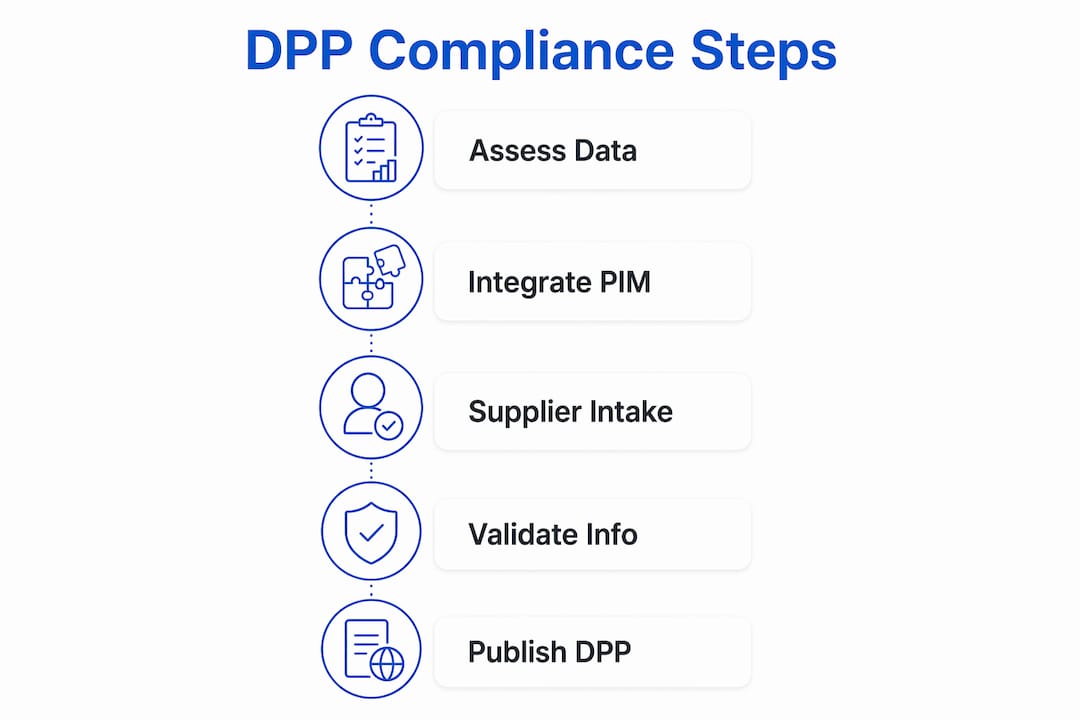
- Discovery and data audit (1–2 weeks): Map existing product attributes, identify compliance gaps, and list which suppliers hold missing data. Treat this as a cross-functional exercise involving supply chain, legal, and ecommerce teams.
- Canonical attribute model (1 week): Define the compliance-ready data model above your storefront fields. Failing to map attributes to GS1 Digital Link or EU semantic standards early causes rework later.
- Supplier data intake setup (1–2 weeks): Establish supplier portal connections or API feeds before attempting bulk passport publishing. Avoid manual spreadsheets as a starting point.
- PIM configuration and product enrichment (2–3 weeks for SMBs; 4–6 weeks for mid-market): Import products from Shopify, configure attribute templates, and begin enriching with compliance fields.
- Evidence ingestion and human review (ongoing from week 3): Upload certificates and declarations, run AI-assisted extraction, and complete human approval before any passport is marked ready.
- DPP publishing and QR embedding on Shopify (1 week): Publish passport pages, generate QR codes, and embed them in Shopify product pages via app or metafield integration.
- Monitoring and iteration (ongoing): Track sync errors, supplier response rates, and data completeness. Run a quarterly review of evidence versions and audit logs.
Pilot-to-production decision gate: Before scaling beyond the pilot SKU set, confirm that supplier attestation coverage exceeds your minimum threshold, that audit log exports are working, and that QR scan rates are measurable. If supplier participation is insufficient after the pilot window, pause and resolve data gaps before expanding.
What privacy and regulatory items must you confirm before publishing DPPs?
Validate privacy-by-design, consent flows, and interoperable data formats before any passport goes live. Article 11 of ESPR sets explicit privacy expectations: any personal data included in a passport requires consent or anonymization workflows, and these must be documented before publication.
Regulatory checks to complete:
- Confirm which ESPR mandatory data points apply to your product category under the relevant delegated act
- Cross-reference GPSR requirements for safety information, economic operator details, and product traceability fields
- Verify that your data model supports the granularity level (model, batch, or item) specified by the applicable delegated act
Security and governance:
- Hosting region controls and encryption at rest and in transit
- Role-based access so supplier-facing and consumer-facing data are separated
- Immutable audit logs and version history — these are the evidentiary backbone if a market surveillance authority requests documentation
On AI-assisted extraction: Automating data extraction with AI helps, but most teams need an AI-plus-human review workflow to maintain evidence accuracy and legal defensibility. A passport published on AI extraction alone, without human sign-off, carries meaningful verification risk.
Pro Tip: Before signing any statement of work with a vendor, ask them to demonstrate audit log exports and show you a documented consent/anonymization workflow for any personal data. If they cannot demonstrate it, that is a gap in their compliance architecture, not yours.
How do you run a pilot and measure whether it is working?
Scope the pilot to a manageable number of SKUs across one supplier set and run it for several weeks. The goal is not perfection — it is proving that the data workflow is repeatable before you commit to full rollout.
| KPI | What it tells you |
|---|---|
| % SKUs with complete compliance attributes | Data coverage and supplier responsiveness |
| Time per passport created (minutes) | Workflow efficiency and tooling fit |
| Supplier evidence response rate | Supplier readiness and portal usability |
| Evidence items validated per SKU | Depth of documentation per product |
| QR scan rate on live passport pages | Consumer engagement and publishing success |
| Sync error rate (Shopify to PIM) | Integration stability |
| Time to remediate a data exception | Operational agility when gaps are found |
Rollback criteria: If supplier attestation response rate falls below a workable threshold after four weeks, pause publishing and address supplier onboarding before expanding. A passport page with incomplete evidence is worse than no page — it creates a false impression of compliance readiness.
Qualitative ROI signals worth tracking: reduced manual audit time, fewer product returns tied to missing care or safety information, and stronger trust signals on product pages. Brands that treat DPPs as competitive advantages report measurable improvements in customer trust and sustainability communication.
Key Takeaways
A DPP-capable PIM paired with DPP Grid is the most practical Shopify-ready approach for fashion and consumer-product brands preparing for ESPR and GPSR compliance.
| Point | Details |
|---|---|
| Shopify needs an upstream PIM | Shopify is a commerce platform, not a PIM; pair it with a compliance-ready data layer. |
| Evidence collection is the hard part | Supplier attestations, document uploads, and audit logs take longer than technical integration. |
| Granularity matters early | Decide model, batch, or item level before configuring your data model — changing it later causes rework. |
| Privacy-by-design is mandatory | Article 11 requires consent or anonymization for personal data in passports before publication. |
| DPP Grid as the next step | DPP Grid imports from Shopify, manages evidence, and publishes QR passport pages; start with a free readiness check. |
The gap most brands discover too late
Most brands I advise underestimate one thing: the technical integration between Shopify and a DPP platform is usually the easy part. The hard part is supplier data readiness. A factory that has been sending you a PDF spec sheet for ten years is not going to suddenly produce a structured JSON attestation because you sent them a portal link. That gap is where DPP programs stall.
The brands that move fastest treat DPPs as a lifecycle data program with a dedicated owner, not an IT project with a go-live date. They audit their supply chain data before they configure anything, they identify which suppliers are likely to be slow, and they build that delay into the project timeline rather than discovering it during the pilot.
DPP Grid supplies the infrastructure and evidence tools. The compliance judgment — what your product must declare, under which delegated act, and when — belongs to your legal team.
DPP Grid gives Shopify merchants a practical starting point
Shopify merchants preparing for EU DPP requirements need more than a compliance checklist — they need a platform that connects directly to their store, collects supplier evidence, and publishes passport pages that hold up to scrutiny. DPP Grid does exactly that: import your products from Shopify, collect attestations from suppliers, run AI-assisted extraction with human review, and publish permanent QR-linked passport pages.

A 14-day free trial gives you enough runway to import a real SKU set, test the supplier data intake workflow, and publish at least one live passport page. DPP Grid provides product-data infrastructure and evidence management. It does not provide legal certification, and it does not claim that using the platform makes your products automatically compliant.
Start with the free DPP readiness checker to assess your current data gaps, or go straight to the DPP Grid platform to begin a trial.
Useful sources
- ESPR Regulation (EU) 2024/1781 — The primary legal text establishing the Digital Product Passport framework and ecodesign requirements. Bookmark this for your legal team.
- EU DPP Registry Implementing Regulation 2026/1778 — Sets out the technical and operational rules for the EU DPP registry, including granularity levels, unique identifiers, and API requirements. Essential for procurement and IT teams.
- Akeneo: Using PIM to Prepare for Digital Product Passports — Practical guidance on how a PIM centralizes sustainability attributes and feeds DPP interfaces; useful for data-model planning.
- Springer: Technical Interoperability and ESPR Legal Compliance — Research on IDTA/AAS template gaps relative to mandatory ESPR data points; recommended for interoperability and standards teams.
- Flatline Agency: Digital Product Passport Explained — Practical DPP how-to covering Shopify integration paths, supplier portal setup, and common implementation mistakes.
- Fabrity: DPP for E-Commerce Explained — Covers Shopify-specific delivery via apps, metafields, and theme customization; good primer for ecommerce teams new to DPPs.
What is the best PIM for Shopify when you need Digital Product Passports?
The most practical approach is a compliance-configured PIM paired with DPP Grid, which imports directly from Shopify, manages supplier evidence, and publishes QR-linked passport pages. Shopify alone cannot handle the evidence management and audit trail requirements that DPPs demand.
Does Shopify support Digital Product Passports natively?
Not yet. Shopify can display DPP information via apps, metafields, and theme customization, but native DPP functionality is still limited. Dedicated integrations are the practical delivery path for most merchants.
What does Article 11 of ESPR require for Digital Product Passports?
Article 11 sets privacy expectations for personal data included in a passport, requiring documented consent or anonymization workflows before publication. Brands must validate these flows before any passport goes live.
How long does a Shopify DPP implementation typically take?
For SMBs, the implementation timeline typically ranges from several weeks to a few months from discovery to first live passports, with supplier data collection often being the most time-consuming phase. Mid-market brands with larger supplier sets generally require longer timelines to full rollout.
Does DPP Grid certify that products are ESPR-compliant?
No. DPP Grid provides product-data infrastructure, evidence management, and publishing tools. It does not provide legal certification, and using the platform does not automatically make a product compliant with ESPR or any other regulation.