
Overview
TL;DR:
- A digital product passport is a verified record that links to a physical garment via QR code or NFC tag. It contains detailed data on material composition, manufacturing, environmental impact, and recyclability, supporting EU circular economy regulations. Early data management prepares brands for mandatory compliance expected around 2028–2029, giving competitive advantages.
What is a digital product passport in circular economy fashion?
A Digital Product Passport (DPP) is a verified digital record linked to a physical garment via QR code or NFC tag. It holds structured data on material composition, manufacturing origin, environmental impact, care instructions, repair guidance, and end-of-life recycling options. For fashion brands selling into the EU, it is becoming the primary mechanism for demonstrating circular economy compliance and supply chain transparency.
The European Commission's DPP framework covers product composition, circularity information, safety data, and regulatory compliance in a single accessible record. Consumers, regulators, and downstream supply chain partners can all access the same verified information.
Key functions a DPP delivers for fashion brands:
- Traceability: Maps materials and manufacturing locations across multi-tier global supply chains
- Compliance evidence: Organizes documentation required under EU regulations in one place
- Consumer trust: Gives buyers verified information on sustainability claims and product care
- Circular commerce: Supports resale, repair, and take-back programs with authenticated product history
- Brand asset value: Tracking garment history and enabling authentication creates competitive advantages that extend well beyond the original sale
Organizations like EADTrust and platforms such as DDP Grid are actively helping fashion brands structure and publish this data ahead of mandatory requirements.
Table of Contents
EU regulations and data requirements shaping fashion DPPs
The EU textile sector, valued at approximately €78 billion, is under significant regulatory pressure to shift toward circular models. Three regulations drive most of the DPP obligation for fashion brands.
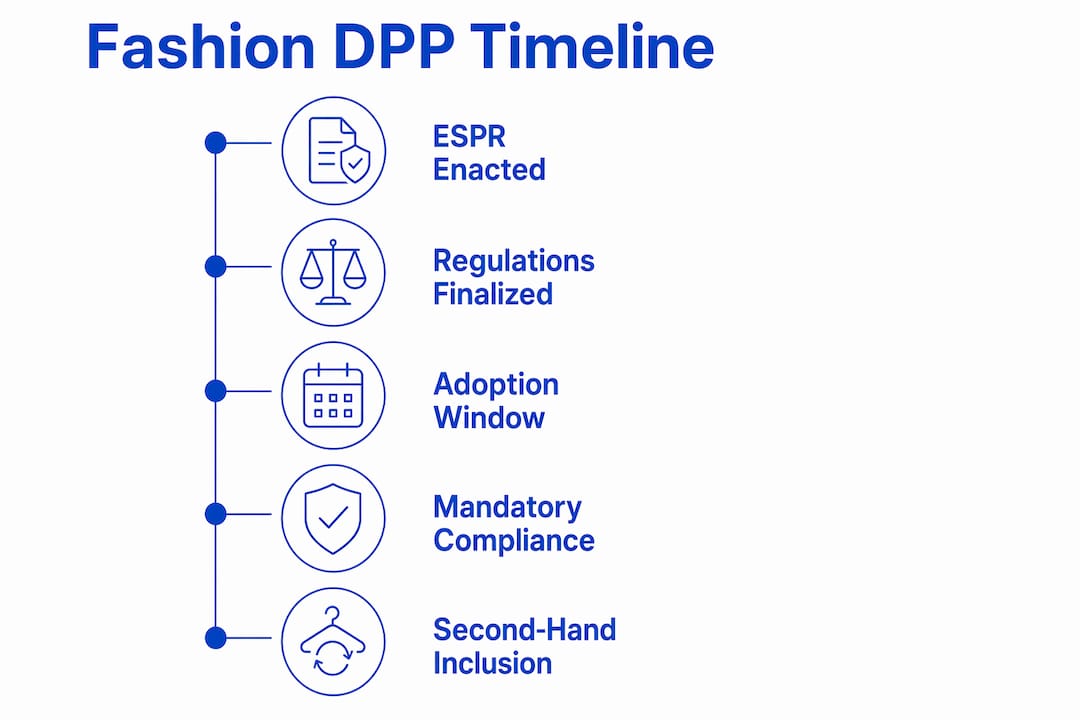
Ecodesign for Sustainable Products Regulation (ESPR) entered into force in July 2024 and explicitly prioritizes textiles in its first working plan. The delegated act setting technical requirements for textile DPPs is expected around 2027, followed by an 18-month compliance window, placing mandatory DPPs for apparel realistically around 2028–2029. ESPR targets durability, recycled fiber content, carbon footprint, substances of concern, reparability, and end-of-life recyclability.
General Product Safety Regulation (GPSR) applies to all apparel, including second-hand, repaired, or refurbished items re-entering commercial supply chains. Brand owners, not third-party factories, bear legal responsibility for product safety documentation and labeling. If no manufacturer or importer is established in the EU, brands must name an EU Responsible Person.
Corporate Sustainability Due Diligence Directive reinforces DPP traceability requirements by demanding verified accountability for environmental and human rights impacts across the supply chain.
€78 billion: The scale of the EU textile market means DPP compliance is not a niche concern. It affects every brand placing garments on the European market.
The data categories brands must manage inside a fashion DPP include material composition, substances of concern, manufacturing locations, environmental impact metrics, repair and recycling instructions, safety documentation, and ownership history.
The operational reality is harder than the regulatory text suggests. Fragmented supply chain data is the primary obstacle: most brands hold inconsistent records on fiber composition, country of origin, and chemical substances across product variants. Closing those gaps requires data audits, supplier engagement, and cross-functional ownership between product, sustainability, and supply chain teams.

Early preparation is a genuine competitive advantage. Brands that build data architecture now avoid the compliance bottleneck when delegated acts are finalized. DDP Grid supports this by letting brands import products from Shopify, CSV, or API, collect supplier data, upload evidence documents, and publish QR-linked passport pages with human-reviewed, AI-assisted data extraction. The platform does not certify compliance but provides the data infrastructure and evidence workflows brands need to demonstrate readiness.
What data must a fashion DPP contain under ESPR?
ESPR requires textile DPPs to cover material composition, recycled content, carbon footprint, substances of concern, durability, reparability, and end-of-life recycling guidance, with exact technical specifications set by the forthcoming delegated act expected around 2027.
When do textile DPPs become mandatory in the EU?
The ESPR delegated act for textiles is anticipated around 2027, with an 18-month adoption window, making mandatory compliance realistic from approximately 2028–2029.
Does GPSR apply to second-hand clothing sold online?
Yes. GPSR applies to second-hand, repaired, and refurbished apparel re-entering commercial supply chains, requiring risk assessments and safety documentation from the brand owner or their named EU Responsible Person.
How does DDP Grid help brands prepare for DPP requirements?
DDP Grid centralizes product and supplier data, manages evidence documents, uses AI to extract and organize product information, and publishes permanent passport pages with QR codes for each product, supporting EU DPP and GPSR readiness workflows.
Key Takeaways
Digital product passports are the central compliance and transparency tool for fashion brands operating in the EU circular economy, with mandatory textile requirements expected around 2028–2029.
| Point | Details |
|---|---|
| DPP definition | A verified digital record linked via QR code covering materials, origin, safety, and end-of-life data. |
| EU textile market scale | The sector is valued at approximately €78 billion, making DPP compliance a broad industry obligation. |
| ESPR timeline | The textile delegated act is expected around 2027, with an 18-month window placing compliance around 2028–2029. |
| Primary implementation challenge | Fragmented supplier data on fiber composition and substances of concern must be resolved before DPPs can be published. |
| Early action advantage | Brands building data infrastructure now avoid costly bottlenecks when final technical requirements are confirmed. |