
Overview

How dynamic and static QR codes actually compare
The core difference comes down to where the destination lives. A static QR code encodes a URL directly into the printed pattern. A dynamic QR code encodes a short redirect URL pointing to a vendor-hosted service that forwards each scan to whatever destination you configure in a dashboard.

That single architectural distinction drives every practical difference between the two formats.
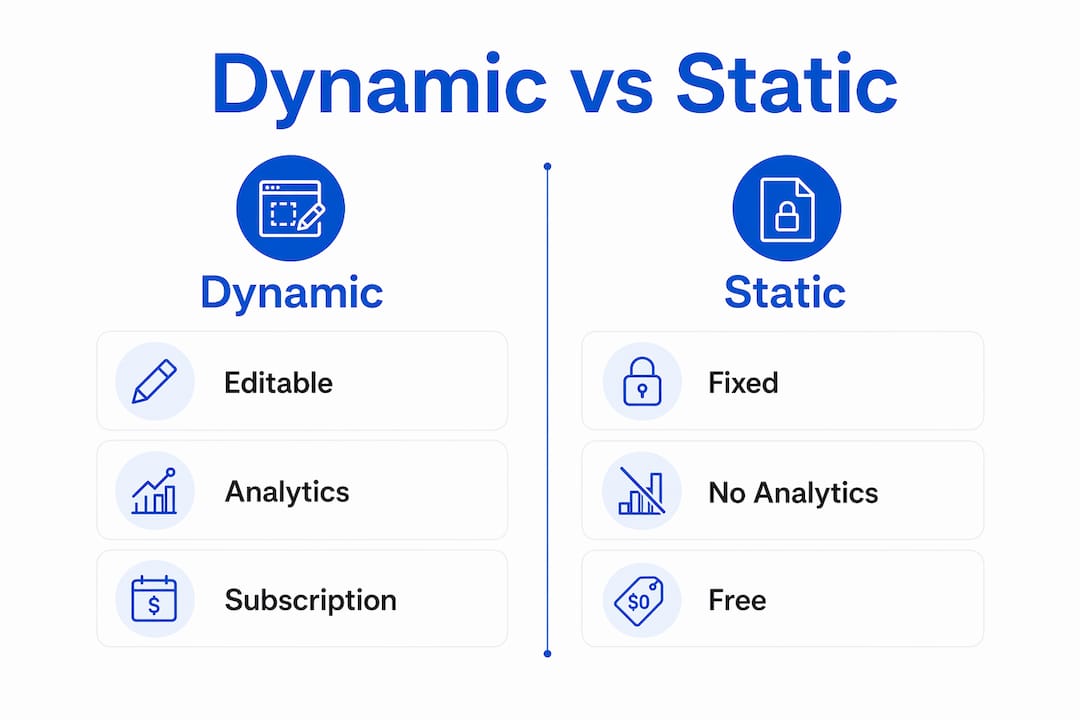
| Feature | Static QR | Dynamic QR |
|---|---|---|
| Editability | Fixed after printing | Update destination anytime |
| Tracking and analytics | None | Per-scan: device, location, time |
| Cost | Free, no subscription | Subscription fees vary depending on vendor |
| Use cases | Permanent URLs, Wi-Fi, vCards | Campaigns, product passports, A/B tests |
| Permanence | Permanent if URL resolves | Depends on vendor staying operational |
| Technical complexity | None | Requires vendor dashboard and ongoing subscription |
Static QR codes at a glance:
- Free to generate with any tool, no subscription required
- Destination URL is permanent and vendor-independent
- No scan analytics or destination updates after printing
- Best for unchanging content: Wi-Fi passwords, contact cards, fixed product pages
Dynamic QR codes at a glance:
- Destination can be changed without reprinting
- Scan analytics available: count, device type, location, time
- Supports geo-targeted redirects and multi-language routing
- Requires ongoing vendor subscription; codes can go dark if the vendor shuts down
How dynamic QR codes work technically
A dynamic QR code encodes a short redirect URL, something like vendor.com/r/abc123, into its printed pattern. When a phone scans it, the device hits the vendor's redirect service, which looks up the current destination in a database and forwards the scan there. The destination is stored server-side, not in the printed code, so you can update it at any time without touching the physical label.
Beyond simple redirects, dynamic codes support features that static codes cannot. Geo-targeted redirects and multi-language routing let a single printed code send users in Germany to a German-language page and users in Poland to a Polish one. Password protection, expiration dates, and per-scan analytics dashboards are also standard on most platforms.
Common use cases where this flexibility matters:
- Marketing campaigns where the landing page changes mid-run
- Product packaging where safety or care information needs updating post-print
- App Store routing that detects iOS versus Android and sends users to the right store
- Digital Product Passports requiring lifecycle data updates over time
Pro Tip: Before committing to a dynamic QR vendor, read their cancellation policy carefully. Most vendors do not keep redirect links alive after a subscription lapses, meaning every printed code goes dark the day you stop paying. Choose a vendor with a published policy that explicitly preserves your codes after cancellation.
What static QR codes are and when they make sense
A static QR code embeds the destination URL directly into the visual pattern of black-and-white modules. Once generated and printed, the encoded URL cannot be changed. If the destination needs updating, you generate a new code and reprint.
The upside is real. Static codes are free forever, require no subscription, and carry zero vendor dependency. As long as the URL they point to resolves, the code works indefinitely. Tools like QR Code Generator PRO, browser-based generators, and open-source libraries all produce static codes at no cost.
Where static codes fall short:
- No scan analytics whatsoever (you can add UTM parameters to the destination URL for basic campaign tracking, but there is no per-scan dashboard)
- No destination updates without reprinting
- No multi-URL routing or geo-targeting
Typical static QR code scenarios:
- Wi-Fi network credentials on a café sign
- Business cards and vCards
- Fixed product catalog pages that will not change
- Event tickets with a single, predictable destination
Key differences between dynamic and static QR codes
The editability gap is the most operationally significant difference. Dynamic codes let you update the destination in a dashboard without touching the printed asset. Static codes require a reprint for every destination change. For a product with millions of units in circulation, reprinting is not a realistic option.
Analytics tell a similar story. Dynamic codes capture scan counts, device types, geographic location, and timestamps through the redirect service. Static codes capture nothing at the QR level. You can recover some data by tagging the destination URL with UTM parameters and reading it in Google Analytics, but you lose per-code granularity.
Security and privacy considerations deserve attention. Dynamic codes route every scan through a third-party server, which logs IP addresses and device data. That creates GDPR obligations for businesses operating in the EU. Static codes involve no intermediary server and collect no personal data by default, which simplifies compliance for lower-stakes use cases.
Vendor dependency is the hidden cost of dynamic codes. Subscription fees typically run $5–$49/month, and if the vendor ceases operations, every printed code stops working. Static codes survive indefinitely because no third-party infrastructure is involved after generation.
Practical use cases for each QR code type
Dynamic codes earn their subscription cost in specific scenarios. A marketing billboard running a seasonal campaign needs per-scan ROI data to justify the spend. A fashion brand shipping thousands of units needs to update care instructions or safety notices after printing without recalling stock. An app download link needs to detect whether the user is on iOS or Android and route accordingly.
Static codes are the right call more often than dynamic QR marketing pages suggest. A restaurant with a stable menu, a business card, a Wi-Fi sign, or a one-time event invitation all have fixed destinations and no analytics requirement.
Practical decision scenarios:
- FMCG or fashion packaging at scale: Dynamic. Reprinting millions of units is economically impossible when a URL changes.
- Small-batch artisan products: Static. Reprinting a short run is cheap; a subscription is not worth it.
- Print magazine ad: Dynamic. Tracking which publication drove scans justifies the cost.
- Wi-Fi password sign: Static. The SSID and password are stable; free is correct here.
- Digital Product Passport: Dynamic, and specifically GS1 Digital Link compliant. EU regulations require updateable lifecycle data.
Pro Tip: For any printed asset with a lifespan under six months and a single fixed destination, static is almost always the cheaper and simpler choice. Save the subscription budget for campaigns where scan analytics genuinely change decisions.
Cost and technical considerations
Static QR codes cost nothing to generate and nothing to maintain. Every major generator, from browser-based tools to open-source libraries, produces them for free with no ongoing infrastructure.
Dynamic codes require vendor services such as servers, databases, analytics, and dashboards. Pricing depends on the vendor and plan, often involving subscription fees and potential volume discounts.
Key cost and risk factors for dynamic codes:
- Monthly or annual subscription fees that scale with code volume or scan counts
- Vendor lock-in: migrating codes to a new provider usually means reprinting
- Link rot risk if the vendor raises prices, changes terms, or shuts down
- GDPR compliance overhead from server-side scan logging
For businesses running a handful of campaigns per year, dynamic codes are a reasonable line item. For permanent product assets, the ongoing cost and vendor dependency often outweigh the benefits.
Why EU regulations favor dynamic QR codes for product traceability
For businesses selling into Central Europe, the choice between dynamic and static QR codes is increasingly shaped by regulation, not just preference.
The EU General Product Safety Regulation (GPSR) explicitly allows product safety and identification information to be delivered digitally via QR codes. Critically, that information must remain accurate and up to date. A static QR code pointing to a page that cannot be updated after printing is structurally incompatible with recall notices or safety updates.
The EN 18220:2026 standard, published as a harmonized standard under EU Regulation 2024/1781 (ESPR), specifies data carrier requirements for Digital Product Passports. It mandates that QR codes used for DPPs support the GS1 Digital Link URI syntax, which enables structured product identifiers to link to updateable, machine-readable product data. GS1 Digital Link transforms a QR code from a simple URL shortcut into a structured data carrier that connects a product's physical identity to its full digital record.
Key regulatory implications for Central European businesses:
- Static QR codes cannot satisfy GPSR requirements for products needing post-sale safety updates or recall notices
- EN 18220:2026 requires data carriers that support lifecycle data accessibility, which static codes cannot provide
- ESPR references QR Code with GS1 Digital Link URI syntax as the compliant data carrier for product traceability
- Market surveillance authorities across the EU are increasingly relying on digital traceability tools to enforce product safety rules
When to choose dynamic versus static QR codes in marketing
The decision tree is straightforward. Ask three questions: Will the destination URL change during the asset's life? Do you need per-scan analytics for reporting? Do you need smart routing by device, language, or geography? Any "yes" points to dynamic; three "no" answers point to static.
For campaign-heavy marketing teams, dynamic codes make sense on high-cost print assets like billboards or magazine spreads, where per-scan ROI data justifies the subscription. For lower-budget or one-off campaigns with a single fixed landing page, static codes with UTM-tagged URLs deliver adequate tracking through Google Analytics at zero additional cost.
Brand consistency matters too. Dynamic codes let you update creative or offers mid-campaign without touching printed materials, which is genuinely useful for seasonal promotions or product launches where messaging evolves.
Tools and platforms for generating and managing dynamic QR codes
For regulatory-grade QR codes tied to Digital Product Passports, the platform needs to support GS1 Digital Link URI syntax and updateable product data. QR Code Generator PRO is a widely used option for marketing-focused dynamic codes across Europe, offering scan analytics, geo-targeting, and multi-language redirect support.
For businesses building product traceability infrastructure, the QR code generator is only part of the picture. The underlying platform needs to manage the product data the code points to, handle version history, and keep information current as products move through their lifecycle. DDP Grid generates product passport QR codes that connect directly to evidence-backed product records, supporting GPSR and ESPR readiness without requiring brands to stitch together separate tools.
Regional considerations for Central European businesses
Central Europe presents a specific regulatory environment that shapes QR code strategy. Germany, Austria, Poland, the Czech Republic, and neighboring markets are all subject to EU GPSR enforcement, which became applicable to businesses from December 2024. Market surveillance authorities in these countries actively monitor product safety compliance, and digital traceability is increasingly part of that enforcement.
Language support is a practical concern. A single product sold across Central Europe may need to serve consumers in German, Polish, Czech, Hungarian, and Slovak. Dynamic codes with geo-targeted redirects handle this automatically. Static codes point to one fixed URL, so multi-language delivery requires the destination page itself to handle language detection.
For ecommerce businesses selling into the EU from outside the region, the GPSR requirement for a responsible person located within the EU adds another layer. That responsible person needs access to current product safety information, which reinforces the case for updateable, dynamic QR infrastructure rather than static codes printed at the point of manufacture.
Key Takeaways
Dynamic QR codes are required for EU-regulated product traceability because they support updateable destinations, GS1 Digital Link compliance, and post-sale safety information, while static codes remain the correct choice for permanent, low-cost, vendor-independent use cases.
| Point | Details |
|---|---|
| Core architectural difference | Static codes encode the URL in the pattern; dynamic codes encode a redirect to a vendor-hosted destination. |
| Cost gap | Static codes have no ongoing cost; dynamic codes typically require a monthly subscription, with fees varying by vendor and plan. |
| Regulatory requirement | EN 18220:2026 and ESPR require GS1 Digital Link QR codes for Digital Product Passports, which static codes cannot fulfill. |
| Vendor risk | Dynamic codes stop working if the vendor shuts down or the subscription lapses; static codes have no such dependency. |
| Decision rule | If the destination will change, analytics are required, or EU product traceability applies, choose dynamic. Otherwise, static is simpler and cheaper. |
What is the main difference between dynamic and static QR codes?
Static QR codes encode the destination URL directly in the printed pattern and cannot be changed after printing. Dynamic QR codes encode a short redirect URL that forwards scans to a destination you can update anytime in a vendor dashboard.
Do dynamic QR codes cost money?
Yes. Dynamic QR codes require a vendor subscription, typically $5–$49/month, to keep the redirect service running. Static QR codes are free to generate and have no ongoing costs.
Are static QR codes compliant with EU Digital Product Passport requirements?
No. The EN 18220:2026 standard and ESPR require QR codes using GS1 Digital Link URI syntax to support updateable product lifecycle data, which static codes cannot provide.
Can you track scans from a static QR code?
Not directly. Static codes have no redirect infrastructure to log scans. You can add UTM parameters to the destination URL and track traffic in Google Analytics, but you lose per-code scan dashboards and device-level breakdowns.
When should a Central European business use a static QR code?
Use static codes for permanent, unchanging content: Wi-Fi credentials, business cards, fixed product pages, or any asset where the destination will not change and scan analytics are not required. For regulated products under GPSR or ESPR, dynamic codes are the appropriate choice.