
Overview

TL;DR:
- The EU's Ecodesign for Sustainable Products Regulation entered into force on July 18, 2024, introducing wider scope and digital product passports. Businesses must now map their products, assign owners, and start evidence gathering before the 2026 DPP registry deadline. Working-plan dates are indicative; legal compliance depends on delegated acts, which can take multiple years to develop and adopt.
Regulation (EU) 2024/1781 — the Ecodesign for Sustainable Products Regulation — entered into force on 18 July 2024. Three dates now drive every compliance project: the first ESPR and Energy Labelling Working Plan was adopted in April 2025; the earliest a delegated act can take effect is 19 July 2025; and the DPP registry and destruction ban triggers are aligned with 19 July 2026. If your team has not mapped products to the working-plan categories and assigned internal owners, those dates are already working against you.
The businesses that must act now are:
- Manufacturers placing products on the EU market under any priority product group
- Importers and authorized representatives responsible for EU market compliance
- Major ecommerce sellers supplying EU consumers, regardless of where they are incorporated
The European Commission, the Ecodesign Forum, and EUR-Lex are the three authoritative channels for tracking every milestone as delegated acts are adopted.
Table of Contents
- What is ESPR and how does the transition regime work?
- What does the ESPR working plan 2025–2030 cover?
- Key regulatory milestones and delegated-act deadlines (2024–2030)
- What does the Digital Product Passport require and when?
- What Central European businesses should do now
- Where to monitor ESPR updates and who to engage
- Key Takeaways
- Why most businesses are reading the ESPR timeline wrong
- FAQ
- Authoritative sources and further reading
What is ESPR and how does the transition regime work?
ESPR replaces the Ecodesign Directive (2009/125/EC) as the EU's primary framework for setting product sustainability requirements. Its scope is substantially wider than the old directive: where the directive covered only energy-related products, ESPR extends to textiles, furniture, iron and steel, chemicals, and other non-energy product groups. It also introduces the Digital Product Passport as a mandatory disclosure tool, not an optional sustainability badge.
The transition regime is the part most businesses get wrong. Legacy Ecodesign Directive measures did not expire when ESPR entered into force. They continue operating until either a new ESPR delegated act replaces them or their own end dates arrive, often as late as 31 December 2026. That means two legal frameworks are simultaneously active right now, and which one applies to your product depends on whether a delegated act has been adopted for your category.
Who is in scope:
- Manufacturers (EU-based and non-EU placing products on the EU market)
- Importers bringing products into the EU
- Distributors and authorized representatives
- Online marketplace operators in certain circumstances
The practical implication: if your product currently falls under a legacy Ecodesign regulation (say, for motors, boilers, or lighting), that regulation's documentation requirements still apply until the ESPR delegated act for that category is finalized. Running both compliance tracks in parallel is not optional.
Pro Tip: Check EUR-Lex for the specific delegated regulation covering your product category. If a legacy measure is still listed as "in force," your product is still under the old framework regardless of ESPR's broader entry into force.

What does the ESPR working plan 2025–2030 cover?
The first ESPR and Energy Labelling Working Plan (Commission communication COM(2025) 187 final) was adopted and published in April 2025. It sets a five-year schedule of priority product groups and includes a mid-term review in 2028 to assess progress and adjust priorities if needed.
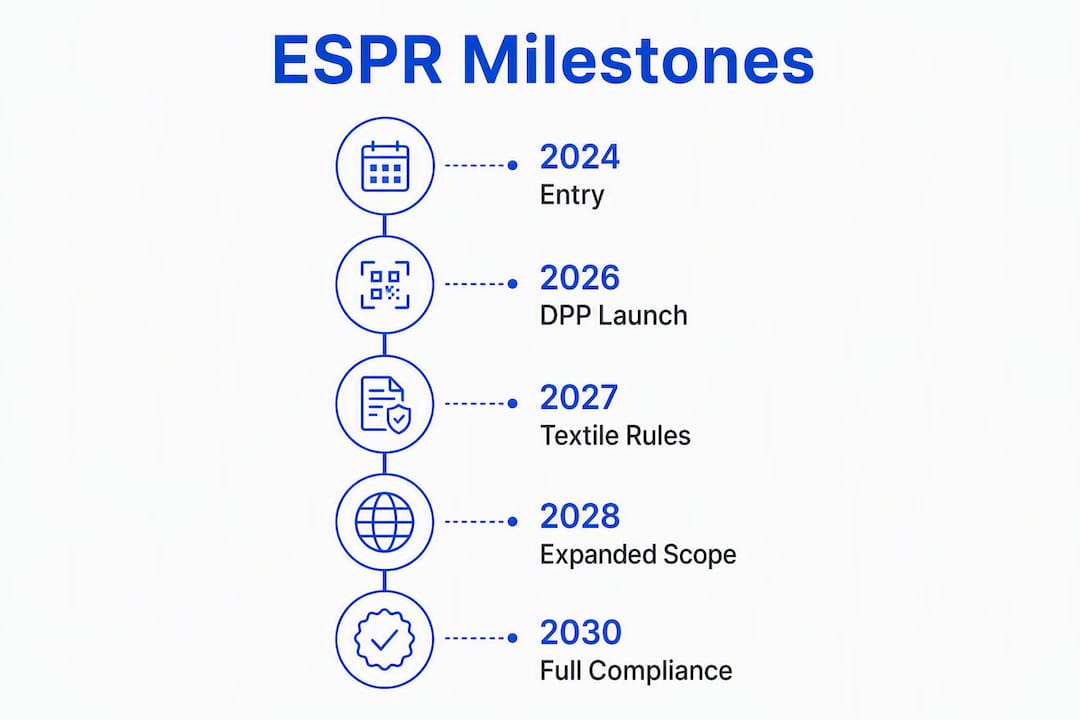
The distinction between legally fixed dates and working-plan indicative dates matters enormously for project planning. A date in the Regulation itself or in an adopted delegated act is binding. A date in the working plan is the Commission's current scheduling intention — it can shift as preparatory studies progress and stakeholder consultations conclude. Treat working-plan dates as planning signals, not legal deadlines.
| Product group | Working-plan target year | Status |
|---|---|---|
| Iron and steel | 2026 | Priority — preparatory study underway |
| Textiles | 2027 | Priority — DPP requirements expected |
| Tyres | 2027 | Priority — preparatory study underway |
| Furniture | 2028 | Priority — indicative |
| Aluminium | 2028 | Priority — indicative |
| Mattresses | 2029 | Priority — indicative |
How to map your product to the working plan:
- Identify your product's CN (Combined Nomenclature) or HS code
- Cross-reference against the working-plan product families in COM(2025) 187
- Assign an internal owner for each category that matches your portfolio
- Set a calendar review for 2028 when the mid-term review may revise priorities
For textiles businesses, the ESPR textile readiness guidance covers how to map product data to ESPR requirements ahead of the 2027 target window.
Key regulatory milestones and delegated-act deadlines (2024–2030)
The ESPR events timeline, from entry into force through the first evaluation cycle, breaks down as follows:
- 18 July 2024 — ESPR enters into force; transition regime begins; legacy Ecodesign Directive measures remain active
- 16 April 2025 — First ESPR and Energy Labelling Working Plan adopted and published (COM(2025) 187)
- 19 July 2025 — Earliest date a delegated act under ESPR can enter into force; sector-specific technical requirements and DPP obligations begin to crystallize
- 19 July 2026 — DPP registry operational milestone; destruction ban and Annex VII triggers activated for covered categories
- 19 July 2028 — First market-surveillance reporting period; mid-term working-plan review
- 19 July 2030 — First full ESPR evaluation; transition measures for many legacy categories expected to conclude
Delegated acts vs. implementing acts: Delegated acts carry the substantive technical requirements — performance thresholds, DPP data fields, labeling obligations. Implementing acts set procedural rules. When a delegated act is adopted for your product group, that is the binding legal trigger for compliance. The working-plan date is when the Commission expects to start the delegated-act process, not when it concludes.
Not every DPP obligation flows through ESPR delegated acts. Some sectors have standalone mandates: battery passports under the Battery Regulation apply from February 2027 for covered categories; detergent DPP requirements are set for 23 September 2029; toy DPP obligations take effect 1 August 2030.
Pro Tip: Subscribe to the Ecodesign Forum's consultation calendar. Preparatory studies — the technical phase before a delegated act is drafted — are where data field requirements are shaped. Engaging at that stage gives your team advance notice of what evidence you will need to collect.
What does the Digital Product Passport require and when?
The DPP registry is the infrastructure backbone of ESPR's transparency requirements. Commission implementation timelines align the registry's operational readiness with 19 July 2026, though the specific data fields and technical specifications for each product group will be confirmed in the relevant delegated act, not in the Regulation itself.
Common DPP data fields and the evidence types that back them:
| Data field | Evidence type |
|---|---|
| Material composition | Supplier declaration, test report |
| Component origin | Certificate of origin, supply chain record |
| Manufacturing location | Factory audit, supplier declaration |
| Repair and care instructions | Brand-authored documentation |
| End-of-life instructions | Recycling scheme certification |
| Economic operator identity | Company registration, authorized-rep appointment |
Manufacturers carry the primary obligation to create and maintain the DPP. Authorized representatives and importers must verify that a DPP exists and is accessible before placing a product on the EU market. For ecommerce sellers, the obligation typically attaches to the economic operator role they hold — importer if they bring goods into the EU, distributor if they handle goods already in market.
Pro Tip: Start with the six core identifiers above and build your supplier intake form around them now. When the delegated act for your category is published, you will be adding fields to an existing structure rather than starting from scratch under deadline pressure.
For a practical overview of what ESPR digital product passports require at the product-data level, that resource covers the evidence and data architecture in detail.
What Central European businesses should do now
Central European manufacturers and importers face the same legal obligations as any EU market participant, but supply chain complexity — particularly for businesses sourcing from outside the EU — adds lead time to evidence collection that Western European peers with shorter supply chains may underestimate.
Operational checklist:
- Classify your products — map each product line to a CN/HS code and cross-reference the working-plan categories in COM(2025) 187. Flag any product still covered by a legacy Ecodesign transition measure.
- Assign owners — each product group needs a named internal owner responsible for tracking the delegated-act timeline and collecting evidence. One person covering "all ESPR" is not a plan.
- Audit supplier data gaps — identify which suppliers cannot currently provide material composition, origin certificates, or batch traceability documents. Those gaps take the longest to close.
- Build your evidence intake process — create a supplier questionnaire covering: material composition by weight percentage, manufacturing location, batch traceability reference, and any existing third-party certifications.
- Prepare your DPP data model — even before a delegated act is finalized for your category, you can structure a data model around the common fields above. That work is not wasted; it accelerates the final compliance step.
- Publish a first-version passport — a QR-enabled product passport page with the data you already hold demonstrates readiness and creates a versioned record you can update as delegated-act requirements are confirmed.
SME vs. large enterprise: SMEs supplying priority product groups (iron and steel, textiles) face the same 2026 and 2027 working-plan windows as large enterprises. ESPR does not create a general SME exemption, though delegated acts may include proportionality provisions. Large enterprises with complex portfolios should prioritize the 2026 DPP registry milestone; SMEs with a narrower product range can focus on one or two product families and build depth rather than breadth.
Pro Tip: CSV or API ingestion of your existing product catalog into a DPP platform takes hours, not weeks. Even a minimal metadata taxonomy — product ID, material description, supplier name, country of manufacture — gives you a structured starting point that a spreadsheet cannot version-control or share with a market surveillance authority.
Where to monitor ESPR updates and who to engage
Staying current on delegated-act publication is not a quarterly task. When a preparatory study concludes or a consultation window opens, the timeline for a specific product group can compress quickly.
Official sources to monitor:
- EUR-Lex — consolidated texts of Regulation (EU) 2024/1781 and all adopted delegated acts; set an alert for CELEX number 32024R1781
- European Commission environment pages — working-plan updates and Commission communications
- Ecodesign Forum — meeting minutes, stakeholder consultation schedules, and preparatory-study outputs published on the Green Forum platform
Practical alert setup:
Who to engage: CEN/CENELEC when harmonized standards are referenced in a delegated act for your category; accredited testing laboratories for conformity assessment; and sector trade associations that hold observer status in Ecodesign Forum working groups. Engaging these bodies before a delegated act is finalized is how you influence the technical requirements, not just comply with them.
Key Takeaways
ESPR's binding legal framework is already active, and the 19 July 2026 DPP registry milestone is the nearest firm operational deadline for most businesses.
| Point | Details |
|---|---|
| Entry into force | ESPR (Regulation EU 2024/1781) entered into force on 18 July 2024; transition measures remain active. |
| Working plan adopted | COM(2025) 187 sets priority product groups from 2025 to 2030 with a mid-term review in 2028. |
| DPP registry deadline | 19 July 2026 is the operational milestone for the DPP registry and destruction ban triggers. |
| Standalone DPP dates | Battery passports apply from February 2027; detergents September 2029; toys August 2030. |
| Act now | Assign product owners, map CN codes to working-plan categories, and start supplier evidence intake this quarter. |
Why most businesses are reading the ESPR timeline wrong
The dominant mistake is treating the working-plan dates as compliance deadlines. They are not. The working plan tells you when the Commission intends to begin the delegated-act process for a product group. The delegated act itself — which is the legally binding instrument — can take one to three years from preparatory study to adoption. That means a product group listed for 2027 in the working plan could have a delegated act entering into force in 2029 or 2030, or earlier if the preparatory study is already advanced.
The inverse risk is equally real. If a preparatory study for your product group is already underway and you are not engaged, the data fields and technical thresholds in the eventual delegated act will be set without your input. The Ecodesign Forum is where that input happens — not at the lobbying stage, but at the technical working-group stage, where evidence requirements and measurement methodologies are actually drafted.
Central European businesses have a structural advantage here that most are not using: proximity to EU institutions and established relationships with national market surveillance authorities. Those relationships are worth activating now, before delegated acts are finalized, not after.
The other thing worth saying plainly: the DPP is not a sustainability marketing tool. It is a machine-readable compliance record that market surveillance authorities will use to verify claims. Brands that treat it as a consumer-facing badge and populate it with aspirational language rather than verified evidence will face the same scrutiny as brands that ignore it entirely. The evidence behind each data field matters as much as the field itself.
When did ESPR officially enter into force?
ESPR (Regulation EU 2024/1781) entered into force on 18 July 2024. Legacy Ecodesign Directive measures continue operating under a transition regime until replaced by ESPR delegated acts.
What is the 19 July 2026 deadline about?
19 July 2026 is the operational milestone for the DPP registry and the trigger date for destruction ban provisions under Annex VII of ESPR. It is not a universal product-compliance deadline — specific obligations depend on the delegated act for each product group.
Which product groups are prioritized in the 2025–2030 working plan?
The working plan (COM(2025) 187) prioritizes iron and steel for 2026, textiles and tyres for 2027, furniture and aluminium for 2028, and mattresses for 2029. These are indicative target years for delegated-act processes, not final compliance deadlines.
Do battery and toy DPP requirements fall under ESPR?
No. Battery passports are governed by the Battery Regulation and apply from February 2027 for covered categories. Toy DPP obligations take effect 1 August 2030 under separate legislation. Not all DPP mandates flow through ESPR delegated acts.
Where should Central European businesses monitor ESPR updates?
Monitor EUR-Lex for adopted delegated acts, the Ecodesign Forum on the Green Forum platform for consultation schedules, and your national market surveillance authority for implementation guidance specific to your country.
Authoritative sources and further reading
The sources below are the primary references for verifying ESPR dates, legal texts, and working-plan details. Use the legal texts when drafting internal compliance memos; use the Commission and Ecodesign Forum pages for implementation timelines and stakeholder schedules.
- Regulation (EU) 2024/1781 — EUR-Lex consolidated text: the primary legal text; use this to confirm scope, transition provisions, and Annex VII triggers
- COM(2025) 187 — ESPR and Energy Labelling Working Plan 2025–2030: the Commission's five-year product-group schedule; use this to map your portfolio to priority windows
- Ecodesign Forum — Green Forum implementation page: stakeholder consultation calendar, preparatory-study outputs, and key dates; use this for advance notice of delegated-act timelines
- European Parliament Legislative Observatory — Procedure 2022/0095(COD): full legislative history from the 2022 proposal through adoption; useful for understanding the political timeline and any future amendment procedures
For internal compliance memos, cite the EUR-Lex consolidated text and the specific delegated act for your product category. For strategic planning, the working plan and Ecodesign Forum outputs give the clearest picture of what is coming and when.

DDP Grid is built for exactly the operational gap this timeline creates: the period between knowing a deadline exists and having the evidence, structure, and published passport to meet it. The platform supports product data import from Shopify, CSV, or API; structured supplier data collection; AI-assisted extraction from PDFs and documents (with human review before anything is published); and QR-enabled passport pages that create a permanent, versioned compliance record. For teams working through the checklist above, that means moving from a spreadsheet to a structured, shareable data model in a matter of days rather than months. DDP Grid does not provide legal certification and does not claim that using the platform automatically makes a product compliant — it provides the data infrastructure and evidence management that compliance work requires.
This article provides general information about ESPR implementation timelines and is not legal advice. Confirm current obligations with EUR-Lex primary texts, your national market surveillance authority, or a qualified legal professional.