
Overview
A leather handbag shipment is waiting at Rotterdam customs. The carrier has the commercial documents, the product codes and the supplier invoice, but the operator can't produce plot-level geolocation or a reference number for the due-diligence statement. The goods may remain blocked while logistics costs accumulate, and the brand's compliance team has to explain why a familiar supplier relationship didn't produce legally usable evidence.
That scenario captures the challenge of the EU Deforestation Regulation, or EUDR. The law isn't just a sustainability declaration added to a product file. It requires a connected chain of information, from the commodity's origin through risk assessment and mitigation to submission in the EU Information System. A leadership team needs clear ownership, supplier controls, data validation and an audit trail that survives customs questions.
A useful supply chain control tower overview can help teams think about the visibility layer, but the operating model must go further. It has to resolve individual products to farms, plots or cattle establishments, retain evidence, record human decisions and preserve the due-diligence reference through the shipment lifecycle.
The practical questions are straightforward. Which SKUs are covered? Who is the operator, and who is the trader? What does each supplier need to submit? How will the business handle conflicting evidence, missing polygons, high-risk findings and changes to a declaration? The answers sit across scope, legal tests, due diligence, geolocation, implementation dates, system interoperability and a disciplined readiness plan.
Table of Contents
- The Customs Hold That Woke Up the Supply Chain
- What the EU Deforestation Regulation Actually Covers
- The Three Legal Tests Every Product Must Pass
- How the Due Diligence Framework Works Step by Step
- Why Geolocation Is the Hardest Data Point to Get Right
- Timelines, Delays and the Implementation Bottleneck
- A Practical Readiness Plan for Brands and Suppliers
The Customs Hold That Woke Up the Supply Chain
The first warning usually arrives as an exception, not a policy memo. A logistics colleague reports that leather handbags have been flagged at Rotterdam. Customs wants the due-diligence statement reference, and the brand's supplier portal contains a tannery certificate, a country of origin and a general declaration about responsible sourcing. It doesn't contain the geolocation of every establishment where the cattle were kept, nor a reliable link between the leather batch and a filed statement.
The shipment is now an operational problem. Goods may be held, demurrage charges can rise, and the brand's reputation is exposed to a question that procurement can't answer from a spreadsheet: where exactly did the relevant commodity come from, and what evidence supports the claim?
The EUDR is built around that question. The regulation requires operators to submit a due-diligence statement before placing covered goods on the EU market or exporting them, and the submission has to be supported by product, quantity, country and geolocation information. For cattle-based products, the geolocation must identify all establishments where the cattle were kept. For other relevant commodities, it must identify the plots of land where they were produced. EUR-Lex's consolidated regulation text sets out those mechanics in the legal framework.
Operational rule: If the sourcing team can't connect a finished SKU to the required origin evidence, the compliance team doesn't have a defensible record.
The answer isn't to ask suppliers for “more ESG data.” It's to define ownership and build a controlled record. Procurement owns supplier participation, compliance approves the legal interpretation, sustainability helps assess origin and land-use risk, logistics preserves the customs linkage, and technology teams make sure the data moves between ERP, PLM, supplier portals and the EU Information System.
The rest of this guide focuses on the seven issues that determine whether the shipment clears: product scope, the three legal tests, due-diligence workflow, geolocation formats, implementation bottlenecks, supplier interoperability and a practical readiness plan. The regulation looks like a market-access rule. In execution, it's an evidence and data-governance programme.
What the EU Deforestation Regulation Actually Covers
Start with the commodity, not the finished product name. The EUDR covers cattle, cocoa, coffee, oil palm, rubber, soya and wood, together with products listed in its product scope. The official Regulation (EU) 2023/1115 text on EUR-Lex is the authority for the relevant products and obligations, so teams should map their customs and product classifications against the legal annex rather than rely on marketing descriptions.
A fashion brand might begin with leather handbags, belts or shoes and trace the relevant material back to cattle. An FMCG business may identify cocoa in chocolate, coffee in roasted products, palm oil derivatives in personal-care goods, rubber in soles or tyres, soya in certain inputs, and wood in furniture, paper or other derived goods. A printed T-shirt isn't automatically covered because it's made of fibre. The relevant question is whether the product falls within the regulation's listed scope and contains, or is made using, a covered commodity.
| Primary commodity | Example derived products | Typical use cases |
|---|---|---|
| Cattle | Leather and other covered cattle products | Handbags, footwear, belts |
| Cocoa | Chocolate and cocoa-based products | Bars, confectionery, beverages |
| Coffee | Covered coffee products | Roasted coffee, ground coffee, drinks |
| Oil palm | Covered palm oil derivatives | Food, cosmetics, personal care |
| Rubber | Natural-rubber products | Soles, gloves, tyres |
| Soya | Covered soya products | Food ingredients, feed, industrial inputs |
| Wood | Furniture, paper and other covered wood products | Furniture, packaging, printed materials |
The market trigger matters more than the supplier's headquarters. The EUDR applies when an operator places covered goods on the EU market or exports them from the EU. It also affects products made available in EU commercial channels, including ecommerce and retail workflows, where the business role meets the regulation's definitions.
Separate the operator from the trader
An operator is generally the party that first places a relevant product on the EU market or exports it. A trader makes relevant products available further down the chain. Those roles don't carry identical obligations, especially after later implementation changes and guidance, so each business should establish its role for every transaction rather than apply one blanket policy.
The practical output is a scope register. Map every relevant SKU, material, customs code, supplier, manufacturing route and EU transaction to a responsible legal entity. Don't let a broad “sustainable materials” field substitute for the commodity-level classification the regulation requires.
The Three Legal Tests Every Product Must Pass
A covered product needs to satisfy three cumulative tests. Passing two isn't enough. The operator must show that the product is deforestation-free, legally produced in the country of production and covered by the required due-diligence statement.
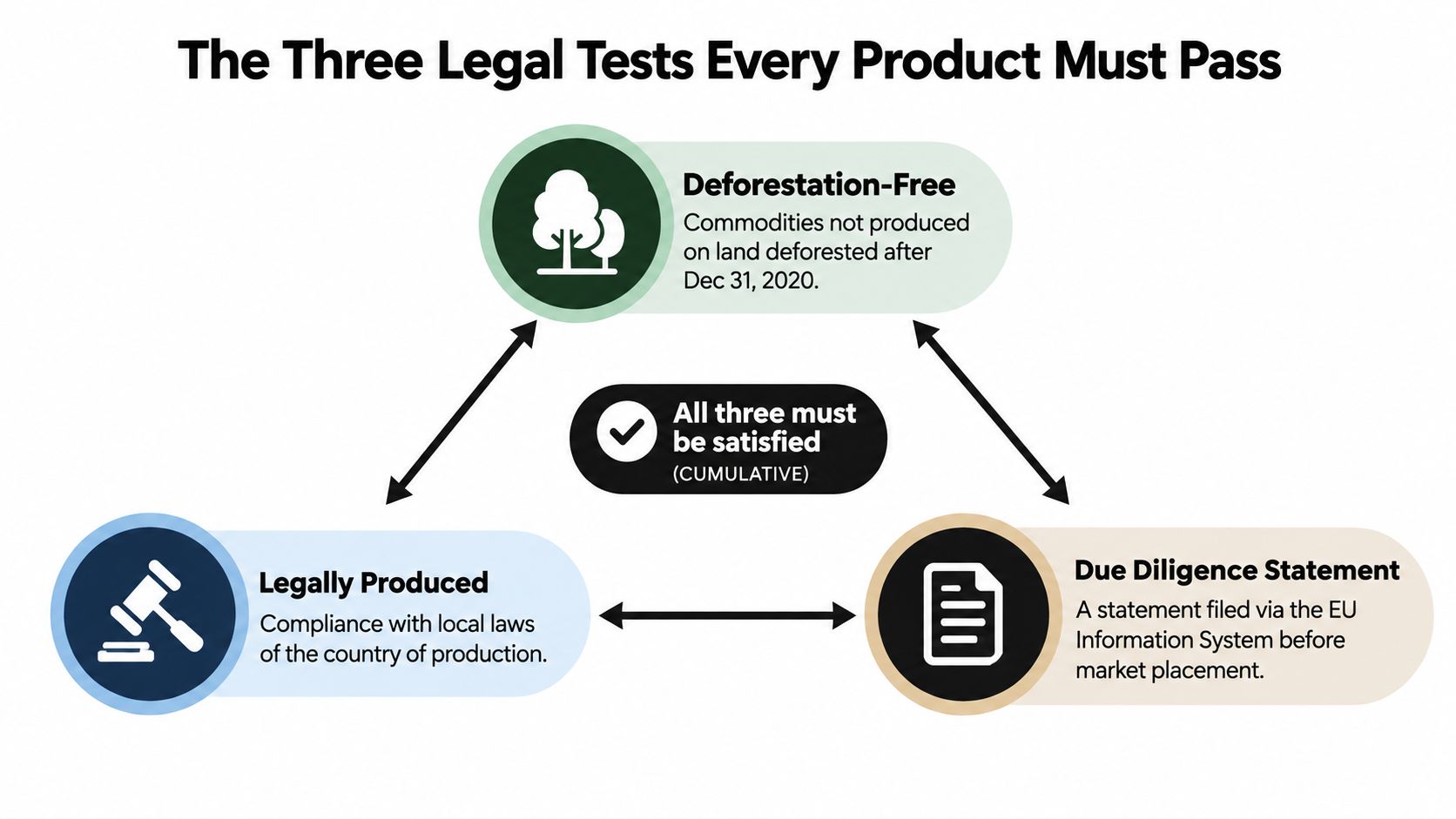
Deforestation-free production
The relevant commodity must come from land that wasn't subject to deforestation after 31 December 2020. For wood, the rule also addresses forest degradation after that date. This cut-off is fixed in the regulation, and the operator needs evidence that allows the relevant land or establishment to be assessed against it. The EUR-Lex provision on the cut-off and market conditions should anchor the brand's internal evidence policy.
A supplier statement saying “no deforestation” is not enough on its own if the business can't connect that statement to the production location, relevant dates and supporting evidence. Satellite analysis, land records, production records and supplier documentation may all contribute, but the record needs clear provenance and a human-approved conclusion.
Legally produced goods
The commodity must also have been produced in accordance with the applicable laws of the country of production. That legal test can touch land-use rights, environmental rules, labour and human-rights requirements, and other country-specific obligations. Compliance teams shouldn't reduce it to a single factory certificate or a generic supplier code.
The evidence set should identify which legal requirements were assessed, who performed the assessment, what documents support it and whether any conflicts remain open. If a document has expired or covers a different site, the system should flag the gap rather than treat the record as complete.
A filed due-diligence statement
Finally, the operator must submit a due-diligence statement through the EU Information System before placing the product on the market or exporting it. The statement creates a reference that needs to remain connected to the relevant product and shipment records.
Decision standard: Treat a missing statement reference as a release-blocking exception, not as an administrative detail to resolve after dispatch.
A product can be legally produced and linked to land with no post-cut-off deforestation, yet still fail the market-access process if the required declaration hasn't been submitted or its supporting data can't be retrieved. The three tests belong in one controlled workflow, with approvals and version history attached to the same item or batch record.
How the Due Diligence Framework Works Step by Step
The due-diligence process has three practical stages: collect the information, assess the risk and mitigate any non-negligible risk before release. Operators should design the workflow so each stage produces a reviewable output, not just a completed form.
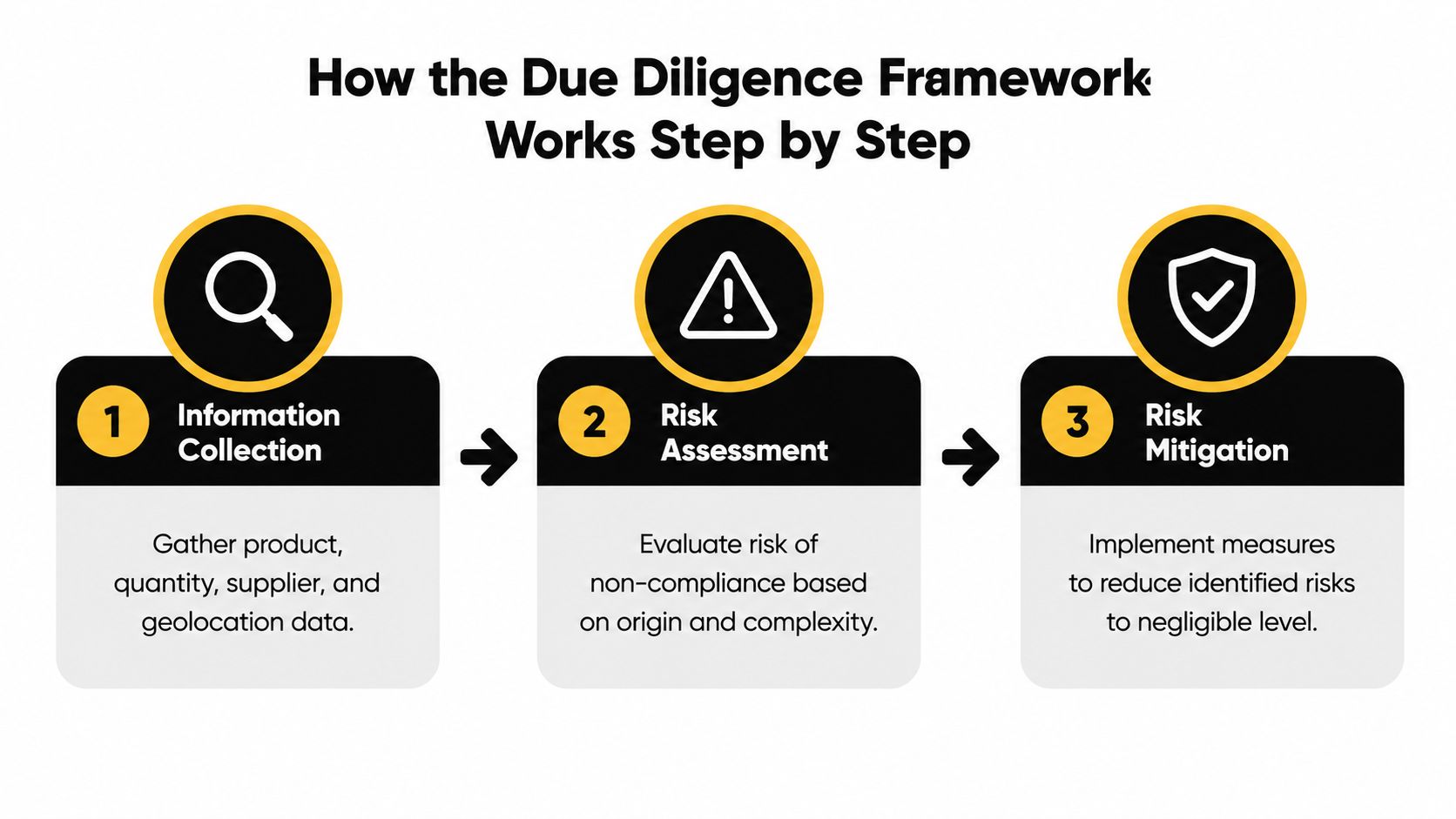
1. Collect the information
The initial file should capture:
- Product identity: Description, relevant product or CN code, quantity and intended EU transaction.
- Production origin: Country of production and the supplier or upstream operator.
- Geolocation: Coordinates for every plot where the commodity was produced, or the required cattle establishments for cattle-based products.
- Legality evidence: Documents and records supporting production under the laws of the country concerned.
- Traceability linkage: Batch, purchase order, shipment or material references that connect origin data to the finished product.
A supplier portal can collect structured contributions, but procurement still needs to review whether the information is complete, current and tied to the right material. Evidence-backed fields should retain the source document, contributor, confidence, conflicts and approval status. A spreadsheet cell with no source or reviewer is a weak control.
For practical supplier workflows, see supplier onboarding software for structured data collection. The important design choice is to make missing information visible early, before a production order becomes a customs issue.
2. Assess the risk
The operator then assesses the risk that the product fails either the deforestation-free or legal-production requirement. The assessment should consider the country and production location, the complexity of the supply chain, the reliability of the evidence, community and land-use context, and any supplier audit findings.
A low-risk origin doesn't remove the need for a controlled record. It changes the intensity of review. The assessment should record the inputs, decision-maker, date, rationale and unresolved concerns, with a clear link to the relevant product and source files.
3. Mitigate before release
If the assessment identifies non-negligible risk, the operator needs mitigation before placing the goods on the EU market or exporting them. Measures can include independent audits, satellite monitoring, additional supplier verification and supplemental documentation. The European Commission's EUDR implementation FAQ should be checked for current clarifications because operational guidance and system arrangements continue to develop.
The final step is submitting the due-diligence statement through the EU Information System. The release control should confirm that the statement is filed, the reference is stored and the declaration version matches the evidence approved by the business.
Why Geolocation Is the Hardest Data Point to Get Right
Geolocation is a legal input, not an optional sustainability enrichment. The operator must collect coordinates for every relevant production plot. A country, region or village name can provide context, but it can't replace the plot-level information the regulation expects.
The format depends on plot size. For plots of 4 hectares or less, widely used compliance guidance allows a single latitude and longitude point. For plots above 4 hectares, the record needs a polygon describing the plot perimeter, with coordinates captured at appropriate precision. The practical geolocation guidance from Coolset explains this point-versus-polygon distinction and connects geodata to risk mitigation.
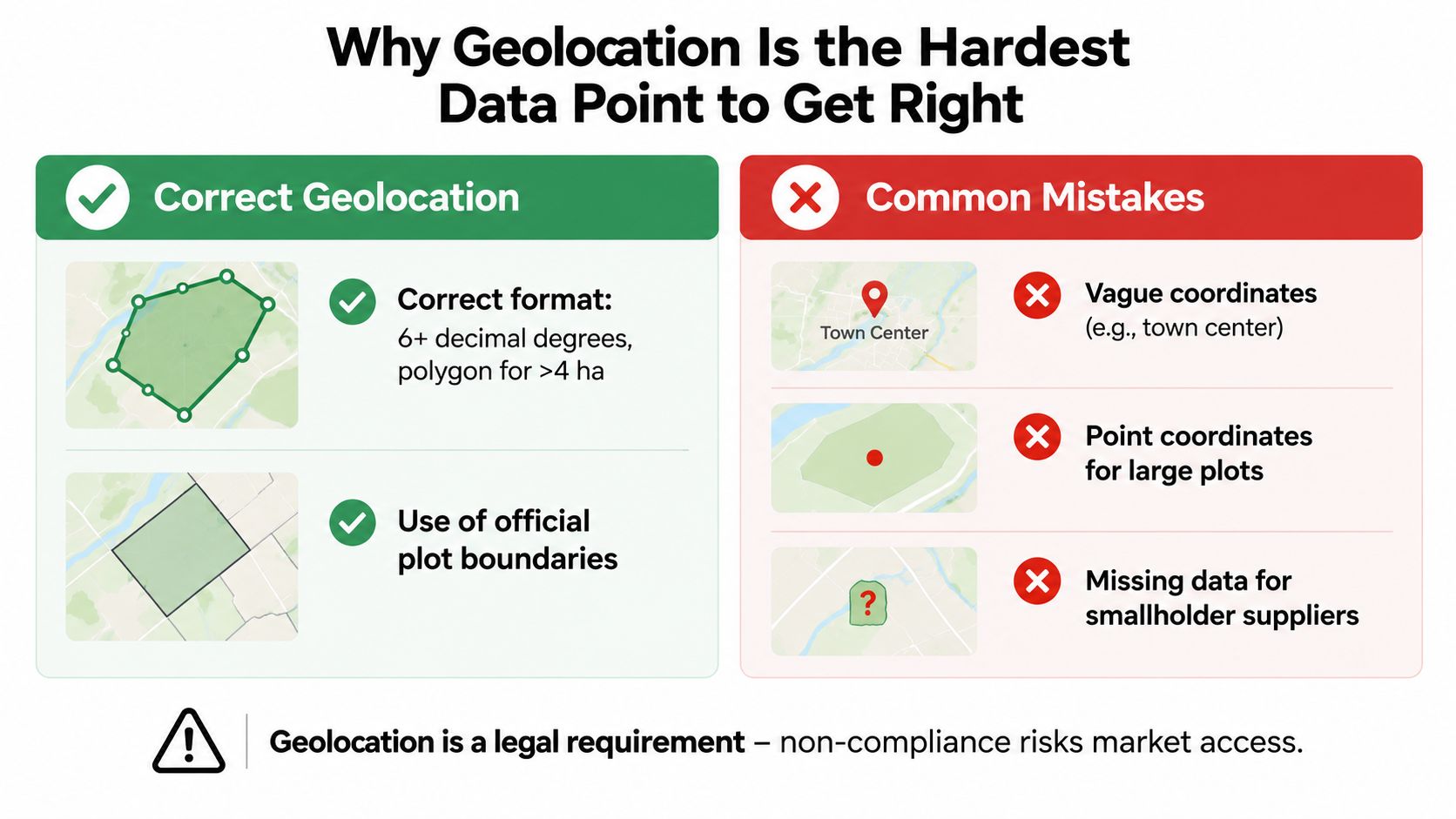
A 12-hectare rubber example
A rubber plantation supplying a sole manufacturer covers 12 hectares. A coordinate placed at the village centre doesn't identify the plantation. A single point at the farm office doesn't describe the production boundary. The supplier needs to provide a polygon that represents the relevant plot, and the brand needs to validate that the geometry is plausible, linked to the supplier's production record and associated with the correct rubber input.
That validation should compare plot size with geometry type. It should flag a point submitted for a large plot, an invalid polygon, duplicate coordinates, missing fields or a geometry that doesn't connect to the supplier and batch record.
Why aggregation creates delays
Smallholder supply chains create a different problem. A trader may aggregate material from many farms, but the legal data requirement still reaches the individual production plots unless a current, applicable simplification changes the obligation for a particular operator category. A village-level declaration can't stand in for missing farm records.
Common failure modes include:
- Approximate coordinates: A town centre or warehouse location is uploaded instead of the production plot.
- Wrong geometry: A point is used for a plot that requires a perimeter polygon.
- Unlinked records: Coordinates exist, but the system can't connect them to the relevant supplier, lot or product.
- Unreviewed files: A geospatial file is stored without a human approval decision or source history.
Control point: Validate geolocation when the supplier submits it. Waiting until customs preparation turns a data-quality issue into a release crisis.
A product-provenance workflow can keep plot records, documents, assessments and approval history connected instead of scattering them across email and shared drives. See product provenance tracking for evidence-linked records for the type of record structure teams should require from their technology partners.
Timelines, Delays and the Implementation Bottleneck
The EUDR entered into force in June 2023. Its current application dates are scheduled for 30 December 2026 for large and medium-sized operators and 30 June 2027 for micro and small operators in the later phase, according to the Council of the European Union's timeline announcement. Micro and small operators already covered by the EU Timber Regulation are scheduled to follow the earlier application date of 30 December 2026 under current official guidance.
Those dates should set the work deadline, not the start date. A brand that waits until the scheduled application date to redesign supplier intake, map product codes, test origin evidence and assign filing ownership will find dependencies spread across procurement, product, legal, logistics, technology and customs relationships.
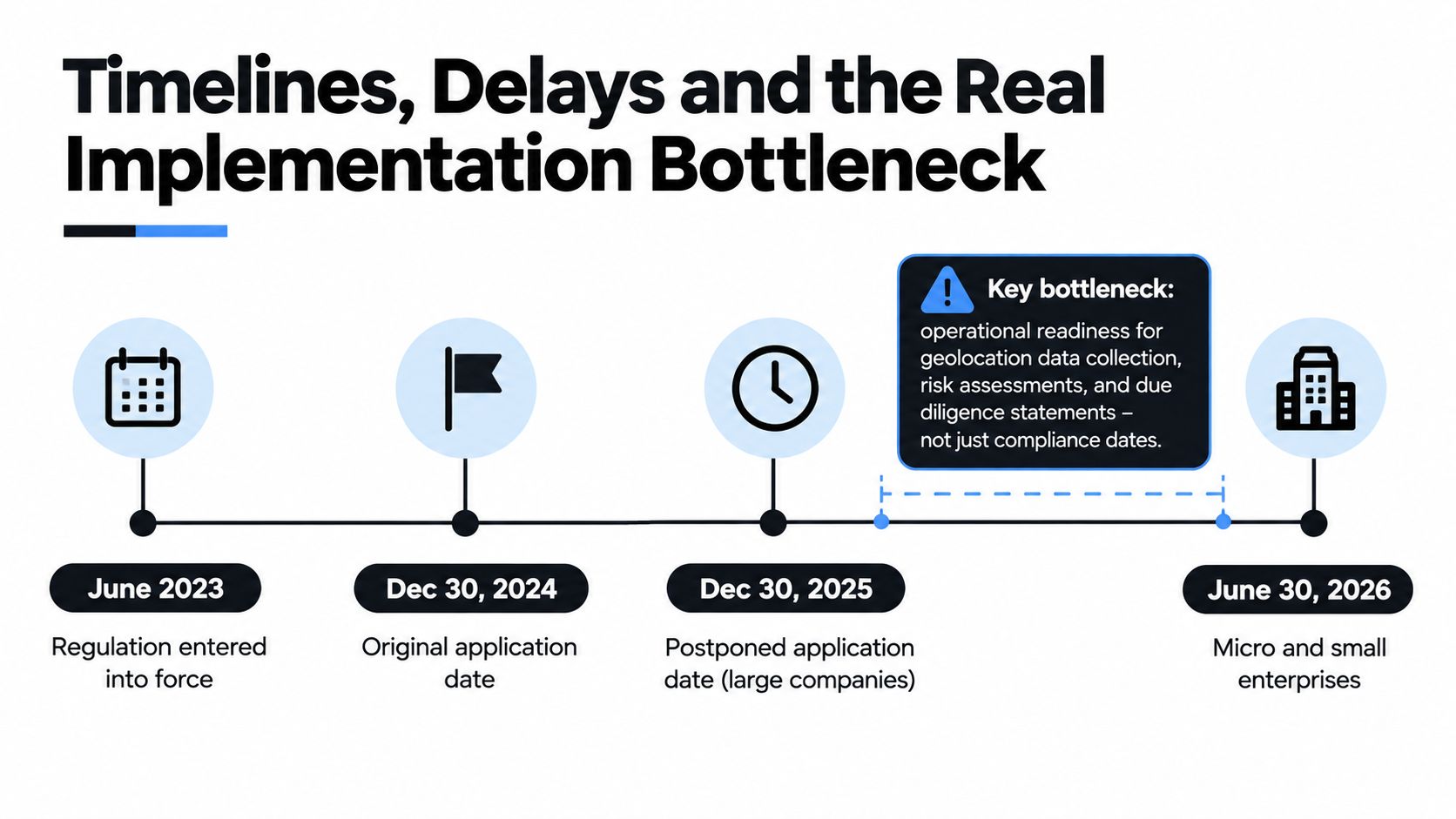
Interoperability is the bottleneck
Consider a cocoa supplier serving an extensive smallholder network. The supplier may hold purchase records and origin declarations, while the brand's PLM stores material specifications and the ERP stores purchase orders. If plot polygons remain in a separate mapping tool, the business still needs a dependable link between each polygon, the cocoa lot, the finished SKU and the due-diligence statement submitted through the EU Information System.
Implementation fails at those handoffs. Common causes include inconsistent identifiers, incompatible file formats, unclear ownership and missing connections between farms, traders, manufacturers, brand systems and customs representatives. A product record must carry evidence from plot-level origin through the submitted statement, with an approval history that can be reviewed later.
Recent reporting described a proposed delay associated with the EU IT system's capacity to handle expected submission volumes. Euronews' coverage of the system bottleneck and timeline changes shows why leadership teams must separate the regulation's legal requirements from the submission infrastructure's readiness.
Build for change without treating proposals as law
The Commission has issued updated FAQs and guidance, while implementation tools continue to evolve. Guidance can clarify how operators should work, but it does not replace the regulation. A delegated act or proposed scope adjustment remains a proposal until it is formally adopted and applicable.
Leadership should fund the data model this quarter. Set stable product and supplier identifiers, connect batches to geolocation, validate evidence versions and control who files and stores declaration references. Review risk-tier mitigation rules against the records, then test whether the same evidence can be retrieved for a product, plot, supplier and statement without manual reconstruction.
A Practical Readiness Plan for Brands and Suppliers
Run the work as a 90-day operating cycle, not a general sustainability initiative. The aim is to expose data gaps while procurement, product, legal, logistics and technology teams can still change the process.
Days 0 to 30
Start with a SKU-level exposure audit. Map leather, palm oil derivatives, rubber, soy, cocoa, coffee and wood inputs to the relevant product classifications, suppliers and manufacturing routes. Flag origins and supply chains that need deeper review, and identify which legal entity acts as operator or trader for each flow.
Assign one accountable owner for the register. Sustainability can support commodity mapping, but compliance should approve the legal scope and procurement should own supplier escalation.
Days 31 to 60
Redesign supplier intake around usable evidence. Request plot or establishment geolocation, production details, legality documents, supplier identifiers and chain-of-custody records. Make the form reject incomplete geometry and require a human review status rather than accepting an unchecked upload.
Store the material in a central, evidence-bound product repository. Supplier compliance documents workflows are useful as a reference for structuring document requests, expiry tracking and reviewable contributions. DPP Grid can support evidence-backed product records, persistent identifiers, supplier contributions, document intake and publication workflows, but it doesn't guarantee EUDR compliance, replace legal advice or certify a product.
Days 61 to 90
Rehearse the due-diligence statement process against the EU Information System. Test a clean low-risk file, a missing-polygon exception, conflicting legality evidence and a high-risk case requiring mitigation. Store the statement reference with the shipment and product records, then run a customs dry run with the freight forwarder and broker.
Keep three parallel controls active:
- Legal sign-off: Approve deforestation-free and legality conclusions before publication or release.
- Training: Teach sourcing, merchandising, logistics, suppliers and ecommerce teams what data they own.
- Exception register: Track missing coordinates, expired documents, unresolved conflicts, rejected suppliers and blocked SKUs.
For fashion and FMCG brands preparing Digital Product Passports, the same governed record can support downstream product identity, evidence provenance, human approval, versioning and persistent QR-linked publication. Use those capabilities to make evidence easier to retrieve, not to imply that a passport itself satisfies the EUDR.
DPP Grid can help centralize evidence-backed product records, supplier contributions, document intake, human approval and persistent product links that support an auditable EUDR workflow. Visit DPP Grid to review the platform and request a demonstration focused on your commodity exposure, supplier data and due-diligence readiness.