
Overview
GS1 Digital Link is the open standard that encodes GS1 product identifiers, such as GTINs, SSCCs, and GLNs, directly into a web URI, so a single barcode can both ring up at checkout and pull up rich digital content on a consumer's phone. No second QR code. No separate marketing sticker. One symbol does both jobs. For brand owners and solution providers in Central Europe preparing for EU traceability requirements, that dual function is the practical foundation everything else builds on.
The core benefits are worth stating plainly before diving into the mechanics:
- A single 2D barcode replaces the need for separate POS and marketing codes on packaging
- Digital content linked to the barcode can be updated at any time without reprinting the barcode artwork
- GS1 identifiers like the GTIN remain the same identifiers your supply chain already relies on
- Batch, lot, serial number, and expiry data can all be encoded in the same URI
- Retailers, supply chain partners, and third-party apps can each extract the data they need from one scan
How GS1 Digital Link encodes product identifiers as web URIs
The URI syntax follows a clear, hierarchical structure. A domain name comes first, then the primary GS1 identification key as a path segment, then optional key qualifiers as additional path segments, and finally any data attributes in the query string.
A typical URI looks like this:
https://example.com/01/09506000134376/10/ABC123/21/XYZ789
Here, /01/ signals a GTIN, /10/ introduces a batch/lot identifier, and /21/ adds a serial number. The order of key qualifiers in the path matters and must follow the sequence defined in the standard. Data attributes like expiry date or net weight go into the query string instead.
Key qualifiers supported by the standard include:
/10/for batch or lot identifier/21/for GTIN serial number/22/for consumer product variant/235/for third-party controlled serialized extension
This structure lets any decoding software extract GS1 identifiers without custom app logic or proprietary database calls. A scanner reads the URI, parses the path segments, and passes the GTIN and qualifiers to the host system exactly as it would from a traditional barcode. The web layer and the supply chain layer share one data source.
What printing GS1 Digital Link barcodes on packaging actually requires
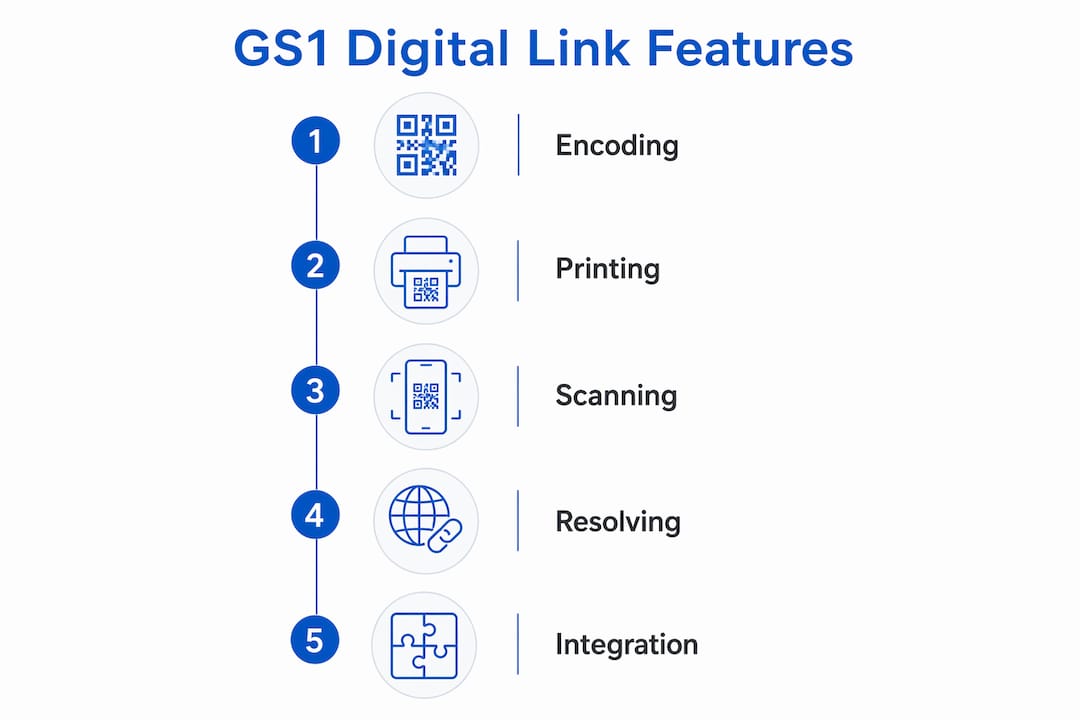
Encoding a GS1 Digital Link URI into a QR code or Data Matrix symbol sounds straightforward, but the physical execution has real failure modes. Symbol size, print contrast, substrate material, and placement all affect whether a scanner reads the code reliably in a retail environment.
A few non-negotiable considerations:
- Symbol size: QR codes and Data Matrix symbols must meet minimum size thresholds for the scanning distance expected at POS and by consumers with smartphones.
- Print contrast: Dark modules on a light background is the default for a reason. Low-contrast printing on metallic, textured, or colored substrates causes read failures.
- Quiet zones: The clear margin around the symbol must be preserved. Crowding the code with other design elements is one of the most common causes of scan failure.
- Error correction: Both QR Code and Data Matrix include built-in error correction, which adds resilience if the symbol is partially obscured or damaged.
- Coexistence with 1D barcodes: During the retail transition period, many brands will carry both a traditional EAN/UPC barcode and a 2D symbol. Placement must prevent scanners from reading the wrong code at POS.
Pro Tip: Test printed symbols across multiple scanning devices, including fixed retail scanners and consumer smartphones, before committing to a full packaging run. A code that reads perfectly on a flatbed scanner may fail on a handheld in poor lighting.
How GS1 Digital Link handles batches, serialized items, and logistics units
The URI qualifier system is what makes GS1 Digital Link genuinely useful for traceability and recall management. The same GTIN can appear in three very different URIs depending on the granularity needed.
For a batch or lot, the URI includes the /10/ qualifier with the lot number. This lets a brand or retailer pull every unit from a specific production run during a recall without touching unaffected stock. For a serialized item, the /21/ qualifier adds a unique serial number, enabling item-level tracking from factory to consumer. For logistics units, the SSCC replaces the GTIN as the primary key, identifying a pallet or shipment container rather than an individual product.
Practical use cases across these levels:
- Batch recall: A food brand encodes GTIN plus lot number. When a contamination issue surfaces, the resolver returns only affected units.
- Serialized luxury goods: A fashion brand assigns unique serial numbers to each item, enabling authenticity verification and ownership transfer at resale.
- Pallet tracking: A distributor encodes SSCCs on pallet labels, giving logistics partners scan-and-go visibility without manual data entry.
- Expiry management: A pharmaceutical distributor adds expiry date as a query parameter, allowing automated alerts for products approaching their use-by date.
The flexibility to move between product model, batch, and individual item identification within the same URI standard is what makes GS1 Digital Link adaptable to complex supply chain hierarchies.
How scanning works differently at checkout versus in a consumer's hands
At a retail POS, the scanner extracts the GS1 identifiers from the Digital Link barcode and passes them to the point-of-sale system exactly as it would from a traditional EAN or UPC barcode. The web URI is parsed, the GTIN is extracted, and the transaction proceeds. No internet connection required at that moment.

When a consumer scans the same code with a smartphone camera, the device reads the URI as a web address and opens a browser. The resolver at the other end of that URI decides what content to serve, which could be a product information page, a sustainability report, allergen details, or a care guide.
| Scanning context | Device | Output | Connection needed |
|---|---|---|---|
| Retail POS | Fixed or handheld scanner | GTIN passed to POS system | No |
| Consumer | Smartphone camera or app | Browser opens linked content | Yes |
| Supply chain | Handheld scanner or app | Identifiers logged to WMS/ERP | Depends on setup |
The challenge for brands is that the same physical symbol must perform reliably in all three contexts. A symbol optimized for consumer scanning at arm's length may not read as quickly on a high-speed retail conveyor. Placement on pack and symbol size need to account for both.
How GS1 Digital Link resolvers work and why they matter
A GS1-conformant resolver is a web server that receives a Digital Link URI request and redirects it to the appropriate content. The resolver is what separates a static QR code pointing to a fixed URL from a dynamic, updateable link that can serve different content to different audiences.
"A GS1-Conformant Resolver connects a GS1-identified object or entity to one or more online resources that are directly related to it. By adhering to a common protocol based on existing GS1 identifiers and existing Web technologies, each GS1-Conformant Resolver is part of a coherent, yet distributed, network of links to information resources." — GS1 Conformant Resolver Standard
Brands can operate their own GS1-conformant resolvers rather than relying on a centralized GS1 service. Running your own resolver gives you direct control over redirect logic, data security, and the ability to update destination URLs without touching the barcode on pack. The resolver advertises its capabilities through a Resolver Description File located at /.well-known/gs1resolver, which lets applications discover what link types and primary keys it supports.
Link types define the relationship between the identified product and the destination resource. For example, gs1:pip points to a product information page, while gs1:instructions points to an instruction manual. A single URI can support multiple link types, and the resolver selects the right destination based on the requesting application's preferences or HTTP headers. If no specific link type is requested, the resolver falls back to a default link, typically the product information page.
How DDP Grid uses GS1 Digital Link for Digital Product Passports in Central Europe
DDP Grid is a UK-based SaaS platform built for fashion, ecommerce, and consumer-product brands that need to create and manage evidence-backed Digital Product Passports. It uses GS1 Digital Link as the identification layer connecting physical products to their digital records, which is directly relevant for brands selling into Central European markets under EU Ecodesign for Sustainable Products Regulation (ESPR) and General Product Safety Regulation (GPSR) requirements.
The platform supports product data at model, batch, and individual-item level, matching the granularity that GS1 Digital Link's URI qualifier system enables. Brands import products from Shopify, CSV, or API, then collect supplier information, upload supporting documents, and use AI to extract and organize product data. Human reviewers approve information before it is published, so the passport reflects verified facts rather than automated outputs.
Key capabilities relevant to GS1 Digital Link implementation:
- QR code generation: Each product passport gets a permanent QR code encoding a GS1 Digital Link URI, scannable without a dedicated app
- Batch and item tracking: Passport records can be created at model, batch, or serialized-item level
- Supplier data collection: Structured workflows gather materials, manufacturing locations, and safety information from suppliers
- Consumer features: Consumers can save products to a digital wardrobe, register ownership, access care and repair information, and transfer ownership at resale
- Regulatory readiness: The platform supports ESPR and GPSR readiness workflows, including EU DPP registry preparation
Pro Tip: DDP Grid does not claim that using the platform automatically makes a product compliant. It provides the data infrastructure and evidence workflows that help brands organize and demonstrate the information regulators and retailers expect.
| Feature | DDP Grid capability |
|---|---|
| GS1 Digital Link QR codes | Generated per product, batch, or serialized item |
| Supplier data import | Shopify, CSV, API |
| Human verification | Required before passport publication |
| Consumer scanning | No app required |
| Regulatory scope | ESPR, GPSR, product traceability |
Implementation challenges in Central European markets
Central European markets present a specific set of conditions for GS1 Digital Link adoption. GS1 member organizations in countries like Germany, Austria, Poland, and the Czech Republic each publish their own guidance, and retailer readiness for 2D barcode scanning at POS varies by chain and country. The Sunrise 2027 milestone, which targets retail POS readiness for 2D barcodes, gives brands a practical planning horizon, but it is a readiness target rather than a hard regulatory deadline.
The most common implementation problems are not technical. Weak barcode governance, fragmented product data across ERP and PIM systems, and unclear ownership of packaging artwork changes create more delays than the URI syntax itself. Brands that treat GS1 Digital Link as a packaging project rather than a data management project tend to struggle most.
Best practices for Central European brands:
- Audit existing GTIN assignments and barcode quality before adding a 2D symbol
- Assign clear internal ownership for resolver management and URI redirect updates
- Coordinate with packaging suppliers and printers early, since not all Central European print vendors have experience with GS1 Digital Link specifications
- Test scanning performance with the specific retail scanners used by your key retail partners in your target markets
- Plan for ecommerce order management integration alongside physical packaging changes
Integrating GS1 Digital Link with ERP and supply chain systems
GS1 Digital Link URIs can be translated to and from GS1 element strings, which means existing ERP and warehouse management systems do not need to be replaced to support the standard. A middleware layer or integration module can handle the conversion, passing familiar GS1 identifiers to backend systems while the URI layer handles web-facing functions.

For brands using SAP, Microsoft Dynamics, or similar enterprise platforms common in Central Europe, the practical integration path usually involves updating the product master data to include the GTIN formatted as a 14-digit number, configuring the resolver or a third-party resolver service, and updating label printing workflows to generate 2D symbols alongside existing 1D barcodes. ERP systems that already manage batch and serial number data are well-positioned, since that data maps directly to the /10/ and /21/ URI qualifiers.
The GS1 open-source toolkit available on the GS1 GitHub repository supports URI construction and translation, reducing custom development effort for solution providers building integrations.
Regulatory considerations for product traceability in Central Europe
The EU regulatory environment is the primary driver pushing Central European brands toward GS1 Digital Link adoption. ESPR requires Digital Product Passports for an expanding list of product categories, with textiles among the early priorities. GPSR, which applies across the EU, requires that product safety information be accessible and traceable throughout the supply chain. Both regulations expect product identification to be machine-readable and linkable to verified data.
GS1 Digital Link satisfies the technical identification layer these regulations require. A GTIN encoded in a GS1 Digital Link URI provides the persistent, unique product identifier that regulators, customs authorities, and market surveillance bodies can use to look up product records. Brands selling into Germany, Austria, Poland, Hungary, and the Czech Republic face the same EU-level requirements, though national market surveillance agencies may apply additional sector-specific rules.
For GPSR readiness, the practical requirement is that safety information must be accessible via the product identifier. GS1 Digital Link resolvers can serve different link types to different audiences, so a consumer scanning a QR code can reach a product information page while a market surveillance inspector scanning the same code can reach a compliance document.
Security and data privacy when using GS1 Digital Link
GS1 Digital Link resolvers must operate over HTTPS, which encrypts data in transit between the scanning device and the resolver. Beyond transport security, brands need to think carefully about what data is exposed at each link type and to whom.
A resolver can serve different content based on the requesting application's identity or the link type requested. Consumer-facing links can point to public product pages, while supply chain links can point to authenticated APIs that require credentials. This separation means sensitive batch or serialization data does not need to be publicly accessible just because the GTIN is encoded in a scannable barcode.
Data privacy considerations under GDPR apply when consumer scanning behavior is tracked. If a brand logs scan events by location, device, or time, that data may constitute personal data under EU law. Resolver operators in Central Europe should review their logging practices against GDPR requirements and ensure that privacy notices cover scanning-related data collection. The GS1 conformant resolver standard itself does not mandate logging, so brands have flexibility in what they record.
Key Takeaways
GS1 Digital Link is the standard that makes a single barcode work for both retail checkout and digital product information, with URI qualifiers enabling batch, serial, and logistics-level traceability across the supply chain.
| Point | Details |
|---|---|
| Dual-function barcode | One GS1 Digital Link QR code handles POS scanning and consumer web access without reprinting. |
| URI qualifier granularity | Lot, serial, and SSCC qualifiers enable traceability from product model down to individual item. |
| Resolver control | Brands can operate their own GS1-conformant resolvers to manage redirect logic and data security. |
| Central European compliance | ESPR and GPSR require machine-readable product identification that GS1 Digital Link directly supports. |
| Data governance first | Weak barcode and product data processes are the most common cause of failed implementations. |
What is a GS1 Digital Link?
GS1 Digital Link is an open standard that encodes GS1 identifiers such as GTINs into web URIs, allowing a single barcode to function at retail checkout and as a gateway to digital product information. The standard is published and maintained by GS1.
What does GS1 stand for?
GS1 stands for Global Standards One. It is the international nonprofit organization that develops and maintains supply chain standards, including barcodes, GTINs, and the GS1 Digital Link standard used worldwide.
What is a digital link in the context of barcodes?
A digital link is a web URI that encodes a GS1 product identifier, such as a GTIN, so that scanning the barcode can trigger both a POS transaction and a web request returning product information, certifications, or traceability data.
Is GS1 membership free?
GS1 membership fees vary by country and company size, set by each national GS1 member organization. Fees are not publicly listed as a single global figure; contact your national GS1 member organization, such as GS1 Germany, GS1 Austria, or GS1 Poland, for current pricing in your market.
Do brands need to use GS1's own resolver?
No. Brands can operate their own GS1-conformant resolvers, giving them direct control over redirect logic, link types, and data security. The GS1-Conformant Resolver Standard defines the requirements a resolver must meet, but it does not require that GS1 itself hosts the resolver.