
Overview

Human-in-the-loop AI (HITL) is a design pattern where humans actively supervise, validate, and control AI outputs at critical decision points, rather than letting the system run fully on its own. It is not a workaround for weak AI. It is a deliberate architecture choice that makes AI systems more reliable, more accountable, and legally defensible, especially under frameworks like the EU AI Act.
For professionals working in Central Europe, this distinction carries real weight. The EU AI Act, which entered into force in August 2024, placing binding human oversight requirements on high-risk AI systems, with non-compliance penalties reaching up to EUR 35 million or 7% of global turnover for violations, and up to 3% of global annual turnover for oversight failures. Getting HITL right is not optional for organizations operating in regulated sectors.
What is human-in-the-loop AI?
Human-in-the-loop AI refers to any AI system designed so that a human can review, correct, or approve outputs before those outputs trigger real-world consequences. The term comes from control systems engineering, where "the loop" describes the feedback cycle between a system and its environment. Placing a human inside that loop means the cycle cannot close without human sign-off.
Three core elements define a genuine HITL setup
- Human review: A qualified person examines AI-generated outputs before they are acted upon, not just logged.
- Correction authority: The reviewer can modify, reject, or override the AI's suggestion without friction or organizational pressure to accept it.
- Feedback integration: Human corrections feed back into the model, improving future outputs over time.
HITL sits within a broader family of oversight models: human-on-the-loop (HOTL), where humans monitor but do not intervene in every cycle, and human-in-command (HIC), where humans retain ultimate authority over the entire system. The right model depends on the risk level, decision volume, and regulatory context of the application.
Under the EU AI Act, high-risk AI systems, covering areas like biometric identification, critical infrastructure, employment screening, and medical devices, must by law support effective human oversight. Article 14 of the Act specifies five distinct capabilities that oversight mechanisms must enable, including the ability to understand system behavior, detect failures, and intervene or stop the system when needed.
How does human-in-the-loop AI actually work?
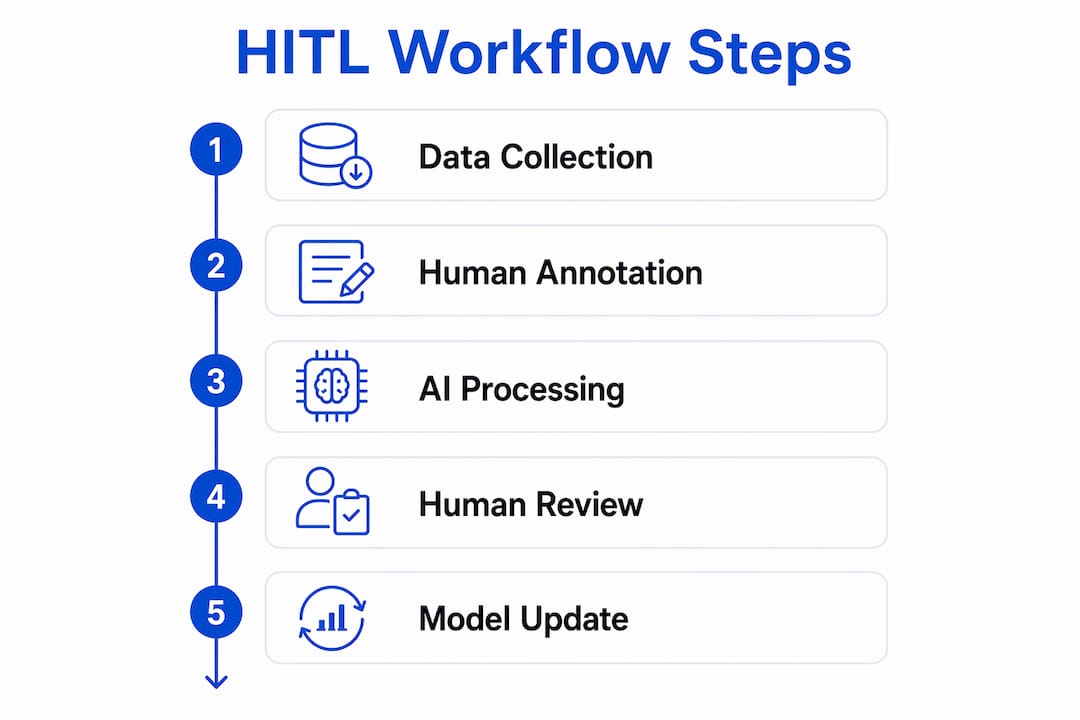
The mechanics of HITL follow a structured workflow with defined human touchpoints. Understanding where those touchpoints sit, and what tools support them, is what separates a real HITL system from one that just claims to have human oversight.
The core workflow
- Input stage: Data enters the AI system. Humans may validate data quality or flag anomalies before processing begins.
- Processing stage: The AI analyzes the input and generates a candidate output, typically with a confidence score attached.
- Review stage: A human reviewer examines the output, the confidence score, and any supporting explanation. They approve, modify, or reject.
- Feedback stage: The reviewer's decision is logged and, where applicable, used to retrain or recalibrate the model.
- Execution stage: Only after human approval does the output trigger a downstream action.
Tools that make oversight real
- Confidence scores that flag low-certainty outputs for mandatory review
- Explainability interfaces (such as SHAP or LIME visualizations) that show why the AI reached a conclusion
- Override controls that are easy to access and carry no social penalty for use
- Audit logs that record every human decision alongside the AI's original suggestion
- Safe-stop functions that let reviewers halt the system without escalation
The HITL workflow requires that interpretable outputs, override options, and real-time intervention capabilities are built in from the start, not bolted on after deployment. Systems that bury the override button three menus deep are not genuinely HITL, regardless of what the documentation says.
Compared to human-on-the-loop, where a human watches dashboards and intervenes only when something looks wrong, HITL is slower but far more reliable for high-stakes decisions. HOTL works well for mature, well-calibrated systems with low error rates. HITL is the right choice when the cost of a single wrong decision is high.

Key benefits of human-in-the-loop AI
The case for HITL goes beyond regulatory compliance. It changes what AI systems can actually be trusted to do.
- Error detection before harm occurs. Human reviewers catch mistakes that confidence scores miss, particularly in edge cases the model was not trained on. Better reliability in high-stakes domains like healthcare and law enforcement depends on this layer.
- Reduced automation bias. Without active design to counter it, humans tend to accept AI outputs uncritically. HITL systems that make override easy and socially supported push back against this tendency directly.
- Continuous model improvement. Human reviewers act as curators, not just checkers. Their corrections provide labeled data that improves model accuracy over time and reduces the volume of cases requiring human review in later cycles.
- Accountability and auditability. Every decision has a named human owner. This matters enormously in regulated industries where you need to show a regulator exactly who approved what and when.
- Legal compliance. For organizations deploying high-risk AI in the EU, HITL is not a best practice. It is a legal requirement under Article 14 of the EU AI Act.
- User and stakeholder trust. Products and services backed by verified human review carry more credibility with customers, partners, and regulators than those relying on fully automated outputs.
Challenges and limitations you should plan for
HITL is not free, and pretending otherwise leads to poorly designed systems that fail under real operating conditions.
- Scalability ceiling. Human attention is finite. As AI output volume grows, the number of reviewers required grows with it, unless the system is carefully designed to route only genuinely uncertain cases to humans.
- Cost. Skilled reviewers cost money. In production environments, HITL operational costs can become a significant budget line, particularly when false positive rates are high and generate unnecessary review queues.
- Human error and cognitive bias. Reviewers bring their own blind spots. Fatigue, anchoring bias, and time pressure all degrade review quality, sometimes below the AI's baseline accuracy.
- Oversight fatigue. High alert volumes erode reviewer attention over time. A system that flags too many low-risk cases trains reviewers to approve quickly without genuine scrutiny, which is the opposite of meaningful oversight.
- Privacy exposure. Human reviewers seeing sensitive data, such as medical records, financial transactions, or identity documents, creates data protection obligations under GDPR. Organizations must define who can see what, under what conditions, and for how long.
- Inconsistency across reviewers. Different reviewers make different calls on identical cases. Without calibration protocols and inter-rater reliability checks, HITL systems produce inconsistent outputs that undermine the model's training signal.
The most common failure mode is not that HITL is too slow. It is that organizations deploy HITL without designing for these constraints, then discover them under production load.
Where HITL AI is applied in practice
Human-in-the-loop approaches show up across industries wherever the cost of an automated error is high enough to justify the overhead of human review.
- Healthcare diagnostics. Clinical decision support tools flag potential diagnoses or drug interactions for physician review. The AI narrows the field; the clinician makes the call. This is standard practice in radiology AI, where systems highlight regions of interest on scans but a radiologist confirms every finding before it reaches a patient record.
- Supply chain and quality control. Enterprise supply chain AI assigns summarizing and flagging tasks to automated systems, while human experts review critical outputs before finalization. The AEGIS-Chain framework, for example, autonomously processes 78.4% of routine decisions while escalating consequential situations to human reviewers, maintaining a complete, immutable decision trace across all operational cycles.
- Identity verification and fraud detection. Financial institutions use AI to score transactions or identity checks, then route borderline cases to human analysts. For certain high-risk identification systems, decisions must be verified by at least two competent human reviewers before action is taken.
- Content moderation. Platforms use AI to detect policy violations at scale, but human moderators review appeals, edge cases, and high-sensitivity content categories where context determines legality.
- Product data management. Platforms like Dppgrid use AI to extract and organize product data from supplier documents, but human users review and approve that information before it is published to a Digital Product Passport. AI-generated suggestions are never automatically treated as verified facts.
- Legal and compliance review. Contract analysis tools flag clauses for attorney review. The AI handles the volume; the lawyer handles the judgment.
Ethical considerations and accountability under EU law
The ethical case for HITL is inseparable from the legal one in Central Europe. The EU AI Act does not treat human oversight as a technical nicety. It treats it as a fundamental safeguard.
Article 14 of the EU AI Act mandates that high-risk AI systems be designed so that human overseers can fully understand the system's capabilities and limitations, detect and address failures, and intervene or stop the system when necessary. Critically, override and stop functions must be easily accessible and socially supported. A culture where reviewers feel pressure to accept AI outputs without question is a compliance failure, not just a design flaw.
Automation bias is the central ethical risk in HITL systems. Humans naturally tend to defer to algorithmic outputs, particularly when those outputs arrive with high confidence scores and the reviewer is under time pressure. Countering this requires more than a checkbox. It requires training, workload management, and organizational norms that treat overrides as normal professional behavior.
Effective oversight requires three things from the organization
- Trained personnel who understand what the AI can and cannot do
- Real authority to override or stop the system without escalation
- Adequate time and tools to make a genuine assessment
The EU AI Act's penalty structure reinforces this. Oversight failures can trigger penalties reaching up to 3% of global annual turnover, while non-compliance carries penalties of up to EUR 35 million or 7% of global turnover. For a mid-sized enterprise, that is a material financial risk.
Transparency and auditability are the other pillars. Every HITL decision should be logged, timestamped, and attributable to a named reviewer. This creates the audit trail that regulators, insurers, and customers increasingly expect, and that organizations need when something goes wrong.
Pro Tip: Build your override rate into your KPIs. A HITL system where reviewers never override the AI is not evidence of a great model. It is evidence of automation bias. Track override frequency by reviewer, by case type, and over time.
How to integrate HITL into existing AI workflows
Retrofitting HITL into a deployed AI system is harder than building it in from the start, but it is rarely impossible. The key is identifying where human judgment adds the most value relative to cost.
Start by mapping your AI workflow and classifying outputs by consequence level. Decisions that are reversible, low-stakes, and high-volume are candidates for automation or HOTL monitoring. Decisions that are irreversible, high-stakes, or legally consequential belong in a HITL queue. This triage logic is what keeps HITL systems from collapsing under their own review burden.
Oversight models should align with risk, volume, maturity, and regulation. Newly deployed or highly impactful systems require HITL, while mature, well-calibrated systems can shift toward HOTL or HIC as confidence in their performance grows. This is not a one-time decision. It is a governance process that should be reviewed regularly.
Technically, integration typically involves adding a review queue between the AI's output layer and the execution layer, connecting that queue to a reviewer interface with confidence scores and explainability outputs, and logging every decision in an audit trail. Most enterprise AI platforms support this architecture natively. The harder work is the organizational design: defining reviewer roles, setting workload limits, and creating escalation paths for cases that exceed a single reviewer's authority.
How HITL shapes the AI model training lifecycle
Human feedback does not just improve individual decisions. It shapes the model itself, across every stage of the training lifecycle.
During initial training, human annotators label data, define edge cases, and set the quality standards the model learns from. The accuracy of that labeling directly determines the ceiling of model performance. Annotation errors at this stage compound through every subsequent training cycle.
During deployment, human reviewers generate a continuous stream of correction signals. When a reviewer overrides an AI output, that correction can be fed back as a new labeled example, gradually shifting the model's behavior toward better alignment with human judgment. This is the mechanism behind techniques like reinforcement learning from human feedback (RLHF), which has become central to large language model development.
Over time, a well-designed HITL system should reduce its own review burden. As the model improves, fewer outputs fall below the confidence threshold that triggers human review. The human workload shifts from routine corrections toward genuinely novel or ambiguous cases, which is where human judgment adds the most value.
Data quality and annotation standards in HITL setups
The quality of human-in-the-loop AI depends directly on the quality of the data humans produce. Annotation is not a commodity task.
Annotation guidelines must be specific enough that two different annotators reach the same conclusion on the same case. Inter-rater reliability, measured by metrics like Cohen's kappa, should be tracked and reported. Low agreement scores signal that the task definition is ambiguous, not that the annotators are incompetent.
Data quality standards in HITL setups typically cover four areas: completeness (no required fields left blank), consistency (the same concept labeled the same way across the dataset), accuracy (labels reflect ground truth, not annotator assumptions), and timeliness (corrections are fed back to the model before the next training cycle, not months later).
For organizations operating under GDPR, annotation workflows that involve personal data require data minimization, access controls, and retention limits. Annotators should see only what they need to complete the task. This is both a legal requirement and a practical security measure.
How to balance automation and human intervention
The goal of HITL is not maximum human involvement. It is the right human involvement at the right moments.

Calibrating the confidence threshold that triggers human review is the most direct lever. Set it too low and reviewers are flooded with easy cases that waste their attention. Set it too high and genuinely uncertain outputs slip through without scrutiny. The right threshold depends on the cost of false positives versus false negatives in your specific context. Calibrating HITL models to reduce false positives is often more critical than maximizing sensitivity, because excessive false alarms cause unnecessary reviews and erode reviewer attention over time.
Workload design matters as much as threshold calibration. Reviewers should handle a volume of cases that allows genuine assessment, not a queue so long that speed becomes the only viable strategy. Rotation schedules, review time limits per case, and mandatory breaks all reduce fatigue-driven errors.
Automation should absorb the routine. Human attention should concentrate on the consequential. A supply chain AI that flags 78.4% of decisions as routine and routes the rest to human review is not cutting corners. It is allocating scarce human judgment where it actually changes outcomes.
For product data workflows, this balance looks like AI extracting and organizing supplier information, with human reviewers approving what gets published. The AI handles volume; the human handles accountability.
Key Takeaways
Human-in-the-loop AI delivers reliable, accountable AI decision making by placing qualified humans at critical points in the workflow, not as a bottleneck, but as a deliberate quality and compliance layer.
| Point | Details |
|---|---|
| HITL is a legal requirement | EU AI Act Article 14 mandates human oversight for high-risk AI, with penalties up to EUR 35 million or 7% of global turnover for violations, and up to 3% of global annual turnover for oversight failures. |
| Override culture matters | Automation bias is the central risk; organizations must actively support reviewers who challenge AI outputs. |
| Humans improve the model | Reviewer corrections feed back as labeled training data, reducing future review volume over time. |
| Calibrate thresholds carefully | Excessive false positives cause oversight fatigue and degrade review quality more than they improve safety. |
| Annotation quality sets the ceiling | Inter-rater reliability and clear labeling guidelines determine how much the model can learn from human feedback. |
What is human-in-the-loop in AI?
Human-in-the-loop AI is a system design where a human reviews, corrects, or approves AI outputs at defined points before those outputs trigger real-world actions. It ensures that AI decisions in high-stakes contexts remain under meaningful human control.
What does human-in-the-loop mean in responsible AI?
In responsible AI, human-in-the-loop means that humans retain genuine authority to understand, challenge, and override AI outputs, countering automation bias and meeting accountability requirements under frameworks like the EU AI Act.
What is the difference between human-in-the-loop and human-on-the-loop?
Human-in-the-loop requires human approval before each consequential action; human-on-the-loop means humans monitor the system and can intervene but do not approve every output. The right model depends on the risk level and decision volume of the application.
What is human-in-the-loop AI in medical contexts?
In healthcare, human-in-the-loop AI means a clinician reviews and confirms AI-generated findings, such as a radiologist approving a scan analysis, before any result reaches a patient record or informs a treatment decision.