
Overview
You may publish a "Made in" origin claim for non-food goods sold in the EU, but the claim must trace back to the EU's non-preferential rules of origin and stand up to scrutiny under consumer protection law. There is no single EU permit or stamp for this. Instead, you need customs-grade evidence: proof of "last substantial transformation," a defensible tariff classification, and documentation you'd hand over if a market surveillance authority or customs officer asked. If your supplier files are thin, get a Binding Origin Information ruling or hold off on the claim.
TL;DR:
- The EU requires customs-grade evidence, such as proof of last substantial transformation and proper tariff classification, to support "Made in" claims for non-food goods.
- Most non-preferential origin determinations rely on whether a product is wholly obtained or results from last substantial processing, with specific rules varying by product chapter and requiring careful classification.
- Collecting and maintaining detailed documents like supplier declarations, BoMs, and import records is essential to substantiate origin claims and must be checked by humans before publication.
- Ambiguous multi-country supply chains should use Binding Origin Information rulings or conservative wording to avoid misrepresenting product origin and potential enforcement action.
- Digital product passports can organize and authenticate evidence backing origin claims, but the legal determination of compliance remains the responsibility of the brand or relevant authorities.
Table of Contents
- What EU Law Actually Requires From a "Made in" Claim
- How Origin Is Determined Under the Union Customs Code
- Evidence and Records to Collect and Publish in a Digital Product Passport
- Pre-Publish Checklist for Origin Claims
- Multi-Country Manufacture and Ambiguous Cases
- Why Evidence Discipline Beats Marketing Instinct
- Turning Origin Evidence Into a Published Passport
- Sources
- FAQ
What EU Law Actually Requires From a "Made in" Claim
Most brands assume there's a single EU regulation dictating when they can print "Made in Italy" or "Made in EU" on a hangtag. There isn't one, at least not for the bulk of non-food consumer goods. The EU has no comprehensive, harmonized rule forcing origin labels onto most products outside specific regulated categories like cosmetics, which carry their own labeling obligations.
That doesn't mean origin is optional. It just moves the obligation from the label to the paperwork:
- Every shipment entering the EU needs a non-preferential origin declared on the customs import declaration, and the declarant carries legal responsibility for that statement.
- If you choose to make a voluntary "Made in" claim on packaging, marketing, or a product passport, the Unfair Commercial Practices Directive treats that claim as a factual assertion, not decoration.
- A misleading origin claim, even an unintentional one, can trigger enforcement action from national consumer authorities regardless of whether labeling was ever mandatory.
UK government research into compulsory origin marking confirms this gap has persisted for years, and it's exactly the kind of regulatory vacuum that invites sloppy claims. Brands treat "voluntary" as "unregulated." It isn't.
How Origin Is Determined Under the Union Customs Code
Non-preferential origin under the Union Customs Code comes down to one of two tests. A product is either "wholly obtained" in one country (raw minerals mined there, crops grown there, animals born and raised there) or it's the result of the last substantial, economically justified processing carried out in the country claiming origin, per Article 60 of the UCC.
For manufactured goods assembled from parts sourced across several countries, "wholly obtained" almost never applies. You're working with the second test, and that's where the mechanics get technical.
- Check for a specific list rule. Annex 22-01 and the Commission's guidance on non-preferential rules of origin set product-specific tests: a change of tariff heading, a defined manufacturing process, or a value-added threshold tied to your HS or CN code.
- Fall back to the residual rule if no list rule applies. Here's the detail most compliance teams miss: for CN Chapters 30 and 41 through 97, which cover a huge share of manufactured consumer goods, the residual rule looks at the value of materials to find the preponderant origin. For Chapters 1 through 29 and 31 through 40, it looks at weight instead. The same product composition gets judged differently depending on which chapter it falls under.
- Request Binding Origin Information if the answer isn't clean. A BOI ruling locks in a customs authority's determination and becomes your strongest evidence if a claim is ever challenged.
Pro Tip: Run your HS/CN classification before you draft any origin claim, not after. The chapter number decides whether you're arguing value or weight, and that changes which supplier invoices actually matter.
Evidence and Records to Collect and Publish in a Digital Product Passport
A "Made in" claim is only as strong as the paper trail behind it. Before that claim goes on a product passport, you need documents that would satisfy a customs auditor, not just a marketing reviewer.
The essential file set looks like this:
- Supplier origin declarations, signed and dated, for every component supplier involved in production.
- A Bill of Materials listing each component's country of origin and the percentage of total value or weight it represents.
- Import declarations (Single Administrative Document), commercial invoices, and process flowcharts showing where assembly and finishing actually happened.
- Assembly or calibration records for products where the "substantial transformation" argument rests on a specific manufacturing step.
Mapping this onto a DPP means assigning each document to a field: declared non-preferential origin, the CN/HS code used to reach that determination, the country where last substantial transformation occurred, a description of the processing steps, and a timestamped evidence attachment for each claim. A well-built passport also logs who verified the entry and when, so the audit trail survives a staff turnover or a supplier switch.
The workflow that actually holds up in practice: import your product catalog from Shopify, CSV, or API, let AI extraction pre-fill the origin and material fields from uploaded supplier documents, then route every AI-suggested entry through a human reviewer before it ever goes live. AI is fast at pulling data out of a BoM or invoice. It is not a substitute for someone checking that the pulled data actually supports the claim you're about to publish.
Pre-Publish Checklist for Origin Claims
Run this sequence before any "Made in" text goes on packaging, a hangtag, or a passport page.
- Confirm the correct HS/CN code for the finished product, since that code decides which list rule or residual rule applies.
- Pull supplier declarations and invoices for every component tied to the origin claim and confirm none of the qualifying work is a minimal operation that doesn't legally confer origin.
- Name a sign-off owner, someone accountable for approving the claim, and record their approval with a date.
- Retain the full evidence file for customs and market surveillance purposes, ideally for the same retention period you apply to other trade documentation.
- Check that marketing imagery, flags, or map graphics near the claim don't imply a different origin than the one your evidence supports. A factually accurate text claim next to a misleading flag icon is still a misleading claim.
Pro Tip: If your sign-off owner can't explain in one sentence why the product qualifies for the origin stated, the claim isn't ready to publish. That single test catches more bad claims than any document checklist.
Multi-Country Manufacture and Ambiguous Cases
Multi-country supply chains are where most origin claims quietly go wrong, usually because a brand mistakes final assembly for substantial transformation. Sewing a label on a garment finished elsewhere doesn't make it locally made. Neither does repackaging, ironing, diluting, or simple sorting; these fall under the EU's minimal operations list, and none of them confer origin on their own.
Common pitfalls worth naming directly:
- Treating "assembled in Country X" as equivalent to "made in Country X" when the components were manufactured elsewhere.
- Assuming a high local labor cost automatically proves substantial transformation, when the actual test is about tariff classification change or specific processing.
- Overlooking that the applicable rule (weight-based or value-based) depends entirely on the CN chapter, as covered above.
When the case is genuinely ambiguous, three options reduce risk: request a Binding Origin Information ruling for a formal determination, use more conservative wording like "assembled in" or "final processing in" instead of a blanket "Made in," or attach qualifying detail directly inside the product passport so the full story is available even when the front label stays simple.
Why Evidence Discipline Beats Marketing Instinct
Most brands treat "Made in" as a marketing lever first and a compliance question second. That ordering is backwards, and it's the single biggest source of avoidable risk in this space. A defensible origin claim starts with the tariff code and the supplier file, not with what sounds good on a swing tag.
AI-assisted data extraction genuinely speeds up the unglamorous part of this work, pulling origin details out of invoices and BoMs instead of someone retyping them by hand. But letting an algorithm's first-pass guess become the published claim, with no human checking it against the actual UCC test, is how brands end up explaining themselves to a market surveillance authority. The evidence-first approach isn't slower marketing. It's the version of marketing that survives an audit, and increasingly, under GPSR's tightening surveillance environment, that audit is more likely to happen than brands realize.
— Vytautas
Turning Origin Evidence Into a Published Passport
Collecting supplier declarations, BoMs, and import paperwork is one problem. Keeping it organized, current, and linked to the right product the day a customer or a customs officer asks about it is a different one. DPP Grid exists for that second problem: a platform built to hold the evidence behind a claim, not just the claim itself.

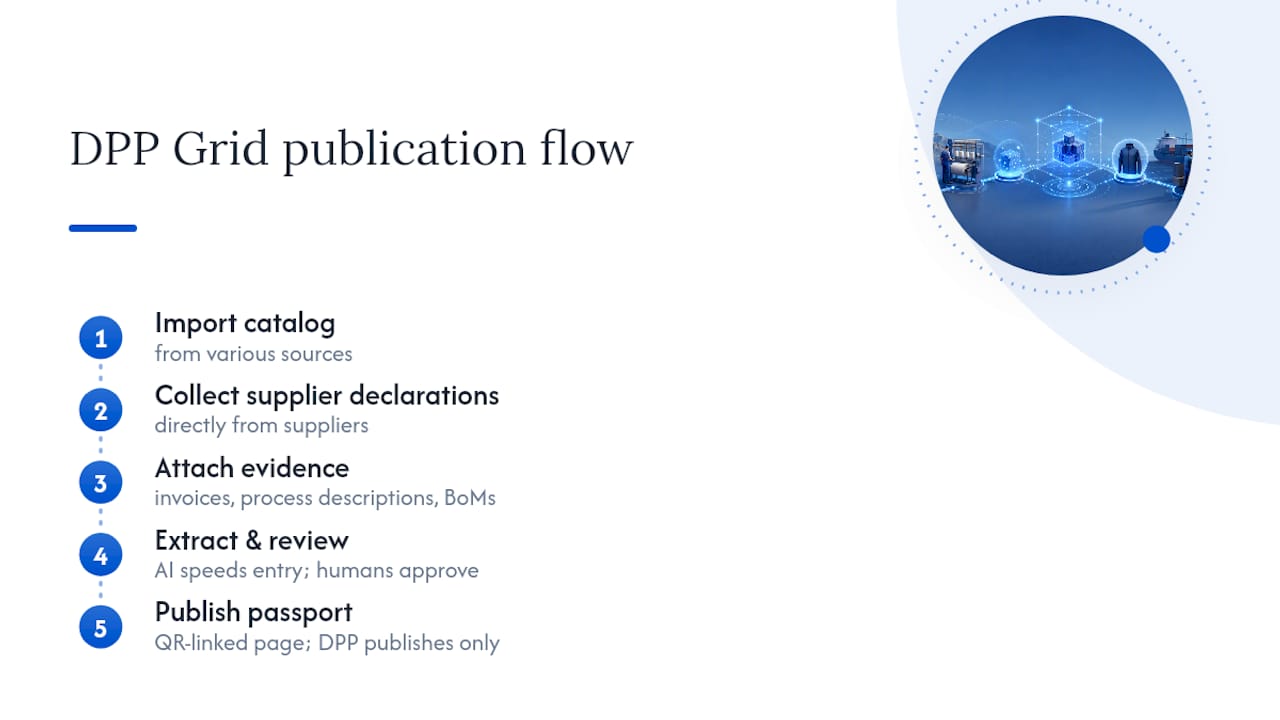
You can import your catalog from various sources, collect origin declarations directly from suppliers, and attach the invoices, process descriptions, and BoMs that back each "Made in" statement to a permanent, QR-linked passport page. AI extraction speeds up the data entry, but every field still routes through human review before publication, so what goes live reflects a decision someone actually made and can defend. DPP Grid organizes and publishes this evidence; it doesn't issue legal certification or guarantee that a specific claim satisfies UCC rules; that determination still rests with your compliance team or a BOI ruling where needed.
If you're preparing origin claims for a product line now, the practical guide to Digital Product Passports for ecommerce walks through how to structure that evidence before you publish, and a free trial lets you test the workflow against your own supplier files.
Sources
Keep these close if you're the person signing off on origin claims:
Is a "Made in EU" Claim Legally Required?
No. Most non-food consumer goods have no mandatory EU origin labeling requirement, though origin must still be declared on customs paperwork for every import.
What Counts as "Substantial Transformation" Under the UCC?
It's the last economically justified manufacturing step that gives a product its essential character, judged against Annex 22-01 list rules or, absent a specific rule, a value or weight based residual test depending on the product's CN chapter.
Does Ironing or Repackaging in the EU Make a Product EU-Made?
No. Operations like simple packaging, labeling, and ironing are classified as minimal operations and don't confer origin, regardless of where they take place.
What Happens if a "Made in" Claim Turns Out to Be False?
A false or misleading origin claim can breach the Unfair Commercial Practices Directive, exposing the brand to enforcement action from national consumer protection authorities even though the original labeling was voluntary.
Should Brands Get Binding Origin Information Before Publishing a Claim?
For any product with an ambiguous or multi-country supply chain, a BOI ruling is the strongest available protection, since it locks in a customs authority's own determination of origin.
Can a Digital Product Passport Help Document an Origin Claim?
Yes. A passport built on DPP Grid can attach supplier declarations, BoMs, and import records directly to a published origin claim, giving brands a verifiable evidence trail without replacing legal judgment on the claim itself.