
Overview
TL;DR:
- Fashion brands must register products in the EU DPP Registry with verified evidence and maintain versioned, QR-linked passports. A successful rollout requires precise granularity, thorough evidence collection, and strong governance before publishing, supported by tools like DPP Grid. The process typically takes weeks to months depending on SKU count, evidence complexity, and integration, with ongoing data management essential to remain compliant.
Register each fashion product in the EU DPP Registry, link a machine-readable passport with a QR code, and maintain versioned evidence throughout the product's life. That is the core of product registration for fashion brands preparing for ESPR and GPSR obligations. DPP Grid is the recommended platform for this end-to-end workflow. This article is explanatory guidance, not legal advice.
- Decide granularity first. Regulation (EU) 2024/1781 requires registration at the level set in the applicable delegated act: model, batch, or individual item. Get this wrong and every downstream identifier is misaligned.
- Collect and attach evidence. Supplier declarations, test reports, fiber composition data, and chain-of-custody documents must be attached before you publish. Missing evidence is the most common reason a passport fails a market surveillance check.
- Register in the EU DPP Registry and publish a QR-linked passport. Commission Implementing Regulation (EU) 2026/1778 mandates automated semantic conformity checks and issues a persistent registration identifier plus a proof-of-registration document. Download and store that proof. Keep versioned records for every update.
Table of Contents
- What is a Digital Product Passport for fashion?
- Why EU regulations are pushing fashion brands to act now
- What data does a fashion DPP need to include?
- How to implement a fashion DPP in four phases
- What integration options do you have?
- What does a DPP rollout actually cost?
- Ongoing data governance keeps your passports defensible
- Common pitfalls when creating fashion DPPs
- How DPP Grid supports fashion brands through this process
- Key Takeaways
- The part most brands underestimate
- Start your DPP pilot with DPP Grid
- Useful sources
- FAQ
What is a Digital Product Passport for fashion?
A Digital Product Passport is a machine-readable product identity record that links a physical item to a hosted dataset via a unique identifier and a digital carrier such as a QR code. The European Commission describes it as a "digital identity card" for products, storing sustainability and circularity information to support legal compliance.
The architecture matters for fashion brands: the EU DPP Registry stores unique identifiers and registration metadata, while the full product data sits with the economic operator or a DPP service provider. You own the data and you are responsible for keeping it accurate and available.
In practice, a jacket's passport might link fiber composition, country of manufacture, care instructions, a repair guide, and recycling instructions, all accessible to a consumer who scans the QR label without installing an app.
Why EU regulations are pushing fashion brands to act now
Two regulations drive the requirement. ESPR (Regulation (EU) 2024/1781) establishes the DPP framework and mandates that passports be accurate, complete, and up to date. Textiles are among the priority product groups for phased DPP introduction, which means fashion brands in Central Europe face earlier timelines than many other sectors.
GPSR (Regulation (EU) 2023/988) adds a parallel layer: traceability, long-term retention of safety documentation, and the obligation to use customer data to notify buyers of recalls. Online marketplaces must not permit listings that lack minimum safety and traceability information.
For importers and brands selling into Central European markets, the DPP Registry registration identifier also functions as a customs release signal and a market surveillance reference. Proof of registration is not optional paperwork. It is evidence.
What data does a fashion DPP need to include?
Get the data fields right before you build any workflow. Here is what a complete fashion passport typically requires:
Product identity
- Unique identifier (URI issued by the DPP Registry), model or batch or item reference, commodity code where required
Materials
- Fiber composition with percentage weights, treatments applied, hazardous substance declarations where relevant
Manufacturing and provenance
- Factory identifier, country of origin, supplier attestations, batch identifiers
Safety, care, and repair
- Care instructions, repairability data and spare parts availability, safety test reports where applicable
End-of-life
- Recycling instructions, material composition for recyclers, take-back program details, resale or reuse information
Supporting documents to collect
- Technical datasheets, test reports, supplier declarations, certificates of conformity, invoices, chain-of-custody evidence
Every field that cannot be evidenced with an attached document is a liability during a market surveillance inspection.
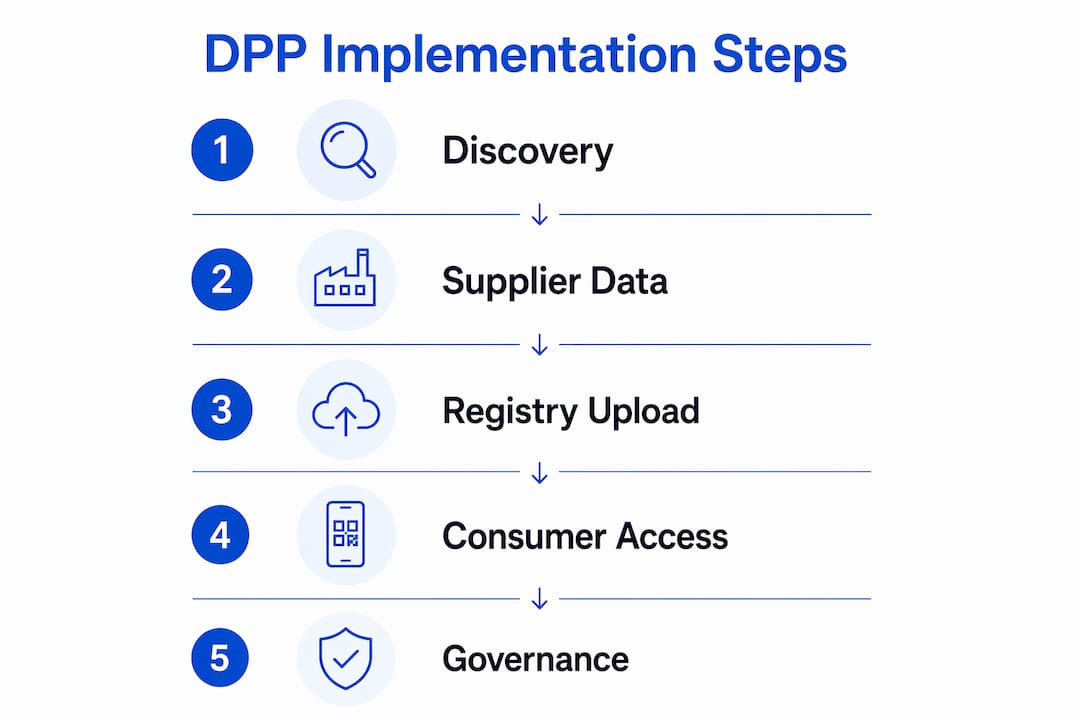
How to implement a fashion DPP in four phases
Start with one product line, prove the workflow, then scale. That sequence saves more time than any other decision you will make.

| Phase | Activity | Typical duration |
|---|---|---|
| A — Discovery & scope | Define granularity, map supplier data, identify priority SKUs for Central Europe | a few weeks |
| B — Data collection | Supplier onboarding, document ingestion (Shopify/CSV/API), AI extraction + human review | a few weeks |
| C — Registry registration | Generate identifiers, submit to EU DPP Registry (UI or API), publish QR passport pages | short pilot duration |
| D — Operations | Versioning, audit trails, recall workflows, consumer ownership features | Ongoing |
A pilot can be completed in a few weeks and full catalog rollout timelines vary depending on SKU count and complexity.
Phase B is where most projects stall. Suppliers rarely have documentation in a consistent format. Build a structured intake process: a supplier portal or a simple form with mandatory fields and document upload. AI-assisted extraction can pull fiber data and factory details from PDFs, but a human reviewer must approve every record before it is published. That approval step is not bureaucracy. It is the control that separates a defensible passport from a liability.
Phase C uses either the registry's secure UI or its API. Implementing Regulation (EU) 2026/1778 requires automated semantic conformity checks at submission, so your data must be clean before it hits the registry endpoint.
What integration options do you have?
Three practical paths connect your product catalog to a DPP workflow:
| Integration mode | Setup effort | Data fidelity | Automation level |
|---|---|---|---|
| CSV / product export | Low | Medium | Manual |
| Shopify app | Low–Medium | High | High |
| Direct API | High | Highest | Highest |
Technical must-haves regardless of mode:
- Persistent unique IDs that survive catalog migrations
- Commodity codes validated against the applicable delegated act
- Secure document storage with MIME-type support for PDFs, images, and certificates
- API endpoints that support versioning and hash verification
- Public QR-linked passport pages with machine-readable JSON-LD or linked-data endpoints
Consumer access and privacy: QR codes must resolve without requiring an app install. Public passport pages should contain only product data, never personal consumer data. Store consumer contact information separately and apply GDPR principles. The ecommerce DPP features that allow consumers to register ownership, transfer a product, or access a digital wardrobe all require a separate authenticated layer, not a public endpoint.
For brands enriching product metadata at scale, tools like AI product description generation can accelerate content creation for passport fields, though all outputs still require human review before publication.
What does a DPP rollout actually cost?
A small pilot covering 50 SKUs typically runs 4–8 weeks. A full catalog rollout for a mid-size fashion brand lands somewhere in the 3–9 month range, with cost driven primarily by four factors:
- SKU count and granularity. Item-level passports cost more than model-level ones. A 500-SKU catalog at item level is a different project than 500 models.
- Supplier evidence complexity. Brands with fragmented or overseas supply chains spend the most time in Phase B. Every missing document adds a resolution cycle.
- Integration depth. CSV import is cheap to set up but creates ongoing manual work. API integration costs more upfront and saves money at scale.
- Human review capacity. AI extraction reduces effort but does not eliminate the need for a reviewer. Budget for that role explicitly.
Questions to ask any vendor before signing:
- Per-record registry fees, if any, and how they scale
- SLA for uptime, data archival, and proof-of-registration availability
- Human review rates and turnaround commitments
- Support for customs proof downloads and market surveillance requests
Ongoing data governance keeps your passports defensible
Governance is the long-term work. Assign ownership before you publish a single passport.
Roles to define:
- Data steward: owns field accuracy and update schedules
- Legal/compliance reviewer: signs off on regulatory claims
- Supplier manager: runs evidence collection and renewal reminders
- IT/DevOps owner: manages API health, storage, and access controls
- Customer operations contact: handles recall notifications and consumer queries
Key processes:
- Version every passport update with a timestamp and hash
- Download and archive proof-of-registration documents from the registry
- Set automated supplier reminders for expiring declarations or certificates
- Maintain a complaint register and safety documentation per GPSR retention requirements
- Log all integration events and supplier document submissions with source metadata
GPSR also requires that brands use customer data to contact buyers directly in the event of a recall. That means your consumer registration data must be structured, current, and accessible to your customer operations team on short notice.
Common pitfalls when creating fashion DPPs
Most failures trace back to three root causes: under-scoping granularity, weak supplier evidence, and no governance owner assigned before launch.
Red flags to watch for:
- Inconsistent product identifiers across your ERP, Shopify store, and DPP system
- Missing batch-to-model linkage when item-level passports are required
- Publishing personal consumer data in a public passport endpoint
- Relying entirely on automated AI extraction without a human approval step
- Ignoring commodity codes until the registry conformity check rejects your submission
Pro Tip: Require supplier-signed attestations at onboarding and capture a document proof-of-receipt at the same time. Chasing evidence retroactively, after a market surveillance request arrives, costs ten times more than collecting it upfront.
How DPP Grid supports fashion brands through this process
DPP Grid handles the full workflow: Shopify and API connectors ingest your catalog, AI-assisted extraction pulls data from supplier documents, and human reviewers approve every record before it is published. The platform generates QR-linked passport pages, supports registry-ready identifiers, and maintains version history and audit trails for each product.
Platform capabilities relevant to fashion brands:
- Shopify, CSV, and API product import
- Supplier document ingestion and AI data extraction with human approval
- Proof-of-registration generation and download
- Public QR-linked fashion DPP pages accessible without an app
- Version history, audit trails, and integration logs
- Consumer features: digital wardrobe, ownership registration, ownership transfer, resale support
Suggested pilot scope:
- Select one product line or your top 50 SKUs
- Ingest via Shopify export or CSV
- Run supplier document collection and AI extraction with human review
- Publish 10 passports and test the registry submission and QR experience
- Measure: time-to-publish per record, percentage of records with complete evidence, cost per published passport
DPP Grid provides product-data infrastructure and readiness workflows. It does not provide legal certification and does not guarantee compliance. Review your specific obligations with qualified legal counsel.
Key Takeaways
Fashion brands selling into Central Europe must register products in the EU DPP Registry, attach verified supplier evidence, and maintain versioned audit trails to meet ESPR and GPSR requirements.
| Point | Details |
|---|---|
| Granularity is the first decision | ESPR delegated acts set whether you register at model, batch, or item level — get this right before building any workflow. |
| Evidence gaps are the main failure point | Attach supplier declarations, test reports, and chain-of-custody documents before publishing any passport. |
| Proof of registration is mandatory | The EU DPP Registry issues a persistent identifier and a qualified-sealed proof document — download and archive it. |
| Governance needs an owner before launch | Assign a data steward, compliance reviewer, and supplier manager before your first passport goes live. |
| DPP Grid covers the end-to-end workflow | Shopify/CSV/API ingestion, AI extraction with human review, QR publishing, and audit trails are all available on a 14-day free trial. |
The part most brands underestimate
The compliance checkbox is the easy part. What actually determines whether a DPP program holds up under scrutiny is the quality of supplier relationships and the discipline of evidence collection. A passport with a QR code and a missing fiber declaration is worse than no passport at all. It signals to market surveillance that you published without verifying.
The brands that get this right early treat supplier onboarding as a data contract, not a favor. They require signed attestations, set renewal schedules, and build the evidence review into their product development calendar rather than bolting it on at launch. That shift in mindset, from compliance task to product data discipline, is what separates a defensible DPP program from one that creates liability.
Start your DPP pilot with DPP Grid
Getting a DPP program off the ground does not require a six-month project. A focused pilot covering 50 SKUs can validate your supplier workflow, registry submission, and QR experience in 4–8 weeks.

DPP Grid's 14-day free trial gives you the full platform: Shopify or CSV import, supplier document collection, AI extraction with human review, QR passport publishing, and proof-of-registration download. The trial is scoped to let you publish real passports, not just explore a demo. After the pilot, your scale plan is built on actual time-to-publish and evidence-completion data, not estimates.
DPP Grid does not provide legal certification. For your specific regulatory obligations, consult qualified legal counsel. Start your trial at dppgrid.com.
Useful sources
Primary EU sources to download and keep on file:
- Regulation (EU) 2024/1781 (ESPR) — the framework regulation establishing DPP requirements, granularity rules, and registry obligations
- Commission Implementing Regulation (EU) 2026/1778 — registration procedures, semantic conformity checks, and proof-of-registration rules
- Regulation (EU) 2023/988 (GPSR) — traceability, retention, recall, and consumer registration obligations
- European Commission DPP overview — plain-language summary of the DPP system, registry architecture, and priority product groups
- EUR-Lex GPSR summary — accessible summary of GPSR obligations for economic operators and online marketplaces
Procurement and compliance teams should download the delegated acts applicable to their product categories as they are published. Those acts define the exact granularity level and required data fields for each product group.
What is product registration in fashion under EU DPP rules?
Product registration for fashion means submitting a Digital Product Passport to the EU DPP Registry at the granularity level (model, batch, or item) required by the applicable delegated act under ESPR, receiving a persistent registration identifier, and maintaining a QR-linked passport with accurate, versioned product data.
Which EU regulations require DPPs for fashion and textile brands?
ESPR (Regulation (EU) 2024/1781) establishes the DPP framework with textiles as a priority product group. GPSR (Regulation (EU) 2023/988) adds parallel traceability and retention obligations, including the requirement to use customer data for recall notifications.
What is the difference between the DPP Registry and the product passport itself?
The EU DPP Registry stores unique identifiers and registration metadata. The full product data, including materials, manufacturing details, care instructions, and supporting documents, is hosted by the economic operator or a DPP service provider such as DPP Grid.
How long does a fashion DPP pilot take to complete?
A focused pilot covering around 50 SKUs typically takes 4–8 weeks, covering data ingestion, supplier document collection, AI extraction with human review, registry submission, and QR passport publishing.
Does using DPP Grid make my products automatically compliant?
No. DPP Grid provides product-data infrastructure, evidence management, and readiness workflows. It does not provide legal certification and does not guarantee compliance. Brands should review their specific regulatory obligations with qualified legal counsel.