
Overview
A compliant Digital Product Passport needs seven categories of recycling-related data: material composition by component, recycled content percentage with provenance, substances of concern with exact locations, disassembly and separation instructions, end-of-life handling guidance, evidence links (certificates, test reports), and a unique identifier tied to the EU DPP Registry. Regulation (EU) 2024/1781 makes accurate, up-to-date end-of-life data a market-access condition, not an optional extra, and product-specific delegated acts will define exactly which fields apply to your category.
- Material composition: component-level breakdown, percent by weight
- Recycled content: percentage by mass, source, chain-of-custody evidence
- Substances of concern: identifier, concentration, exact component location
- Disassembly instructions: fastener types, tools, separation sequence
- End-of-life guidance: recommended treatment route, hazard notes
- Provenance evidence: supplier declarations, batch numbers, test reports
- Unique identifier: linked to the EU DPP Registry for lookup
Pro Tip: Before writing a single field, run a gap analysis against this list product by product. Most manufacturers find they already hold 60 to 70 percent of this data scattered across supplier emails and spec sheets. The work is consolidation, not creation.
Start with your highest-risk product lines. Electronics, batteries, and blended-fiber textiles face the earliest and strictest delegated acts, so mapping those first buys you time on everything else.
Key Takeaways
Recycling data in a Digital Product Passport works only when material composition, recycled content, substance locations, and disassembly steps are all backed by verifiable evidence and published in a machine-readable, persistent format.
| Point | Details |
|---|---|
| Map before you build | Run a gap analysis against the seven required field categories before designing any template. |
| Prioritize by risk | Electronics, batteries, and blended textiles face the earliest delegated acts; map these product lines first. |
| Location beats labeling | Substances of concern need a component-level location, not a general product-level disclosure. |
| Use dual-format instructions | Pair short machine-readable disassembly steps with a linked visual guide for workshop use. |
| DPP Grid supports the workflow | It handles data import, supplier evidence collection, and human-verified publishing, but does not certify legal compliance. |
Table of Contents
- Where Recycling Information Is Required by Law
- What to Capture for Recyclers: A Field-by-Field Breakdown
- Making Disassembly Instructions Useful on the Workshop Floor
- How Recyclers Actually Find and Trust the Data
- A Step-by-Step Plan to Collect, Verify and Publish Recycling Data
- Who Gets to See What: Access Rights for Recyclers and Authorities
- Operationalizing This With DPP Grid
- The Gap Between Passport Design and Passport Usefulness
- Get Your Recycling Data Passport-Ready With DDP Grid
- Sources
- FAQ
Where Recycling Information Is Required by Law
The legal foundation for recycling data in a DPP sits in a handful of specific clauses. Article 7 of the ESPR sets the general obligation: products covered by a delegated act cannot be placed on the market without a passport, and that passport's data must be accurate, complete and kept current. Articles 9 through 12 spell out what the passport must technically contain and how it connects to the data carrier and registry entry. Article 14 governs the delegated acts themselves, the mechanism that turns the regulation's general principles into product-specific field lists.
This structure matters because the ESPR itself does not tell a toy manufacturer or a battery importer exactly which recyclability fields to fill in. That level of detail arrives through delegated acts written for each product group, and they will differ meaningfully:
- A delegated act for furniture might require joinery and fastener disclosure for disassembly.
- One for electronics will likely demand component-level hazardous substance mapping.
- Batteries already face separate, more granular recycled-content and chemistry disclosure rules.
Recycling data in a DPP also has to sit consistently alongside existing waste law. Directive 2008/98/EC still defines what counts as waste, extended producer responsibility, and treatment obligations at the member-state level. A DPP does not replace that framework. It feeds it: recyclers use passport data to decide how a product should be classified and processed once it reaches end of life, but the legal definitions of waste and treatment obligations remain governed separately.
What to Capture for Recyclers: A Field-by-Field Breakdown
Regulatory language tells you what categories to cover. Recyclers need specificity within each one. Here's what each field should actually contain.
- Material composition. Break this down by component, not by product. A jacket isn't "polyester." It's a shell fabric at a given percentage, a lining, a zipper alloy, and a button material, each listed separately with percent by weight. Using standardized material codes where they exist keeps the data machine-parseable rather than a paragraph of prose a sorting line can't use.
- Recycled content. State the percentage by mass, and be specific about whether it comes from pre-consumer or post-consumer sources, since that distinction affects how a recycler or auditor weighs the claim. Back it with a certificate or chain-of-custody document rather than a supplier's verbal assurance.
- Substances of concern. List the CAS or EC number, the concentration, and precisely which component contains it. "Contains flame retardant" tells a recycler nothing useful. "Flame retardant in the seat cushion foam, 3% by weight" tells them where to cut and what to isolate.
- Provenance. Every claim above needs a paper trail: supplier declarations, batch numbers, lab test reports, all linked as evidence inside the passport rather than referenced and stored elsewhere.
Pro Tip: Treat substances of concern as the field most likely to get you audited. Vague or missing location data here is the single most common gap compliance teams find when they review supplier-submitted passports.
Making Disassembly Instructions Useful on the Workshop Floor
A disassembly instruction that only satisfies a checklist is worthless to the person actually standing at a recycling line with a screwdriver. Useful instructions follow a clear structure: a stepwise sequence, the fastener types involved, any hazard notes (batteries, sharp edges, pressurized components), the tools required, where the separation points are, and what yield to expect from each material stream.
The best approach uses two formats at once. A short, machine-readable sequence of steps sits in the structured DPP data for automated systems and quick lookups. A linked visual, whether a diagram or a short PDF, serves the person doing the physical work, because nobody wants to parse a JSON field while holding a torque driver.
- Simple consumer goods (a ceramic mug, a basic plastic container) need minimal disassembly data, often just a material call-out.
- Electronics need component-by-component breakdown: battery removal sequence, circuit board separation, casing fastener types.
- Textiles need fiber-blend disclosure plus notes on trims, zippers, and any bonded or laminated layers that resist standard shredding.
Pro Tip: If your product has more than three material types bonded together (laminate, foam plus fabric, multi-metal assemblies), commission a real disassembly photo sequence. Text alone rarely captures where a hidden fastener sits.
How Recyclers Actually Find and Trust the Data
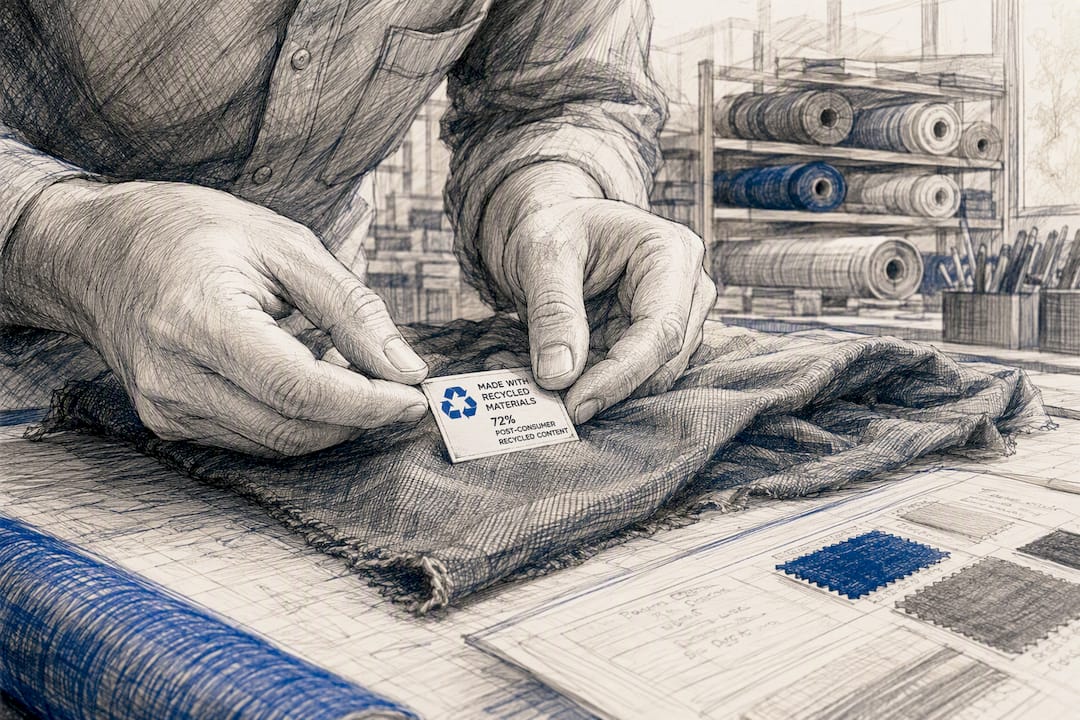
A recycling line only benefits from a passport if it can locate the data fast and trust it hasn't been altered. That comes down to carrier choice, identifier strategy, and format persistence.
QR codes work well for consumer-visible access and low-cost printing, but a recycler on a fast-moving sorting line often needs something scannable without manual handling. RFID tags support automated identification at conveyor speed, which matters more for high-volume streams like electronics or packaging than for a one-off garment scan. Many manufacturers end up using both: QR on the product for consumers and repairers, RFID embedded for automated recycling infrastructure.
Identifier strategy depends on what varies across your product run. If material composition and substances of concern are identical across an entire model, a model-level identifier is sufficient. If recycled content percentage shifts batch to batch, as it often does with recycled plastics or recycled fiber blends, you need batch-level identifiers so a recycler isn't working from stale averages.
- Model-level ID: consistent composition across the whole run
- Batch-level ID: recycled content or supplier source varies by production run
- Serial-level ID: high-value items needing individual provenance tracking
On persistence, the harmonised EN standards covering DPP data exchange, storage and interoperability exist specifically to stop recycling data from becoming unreadable a decade after publication. Products can outlive the software systems that first hosted their passport, so building on open, standard formats rather than a closed proprietary schema is the practical safeguard against that risk.
A Step-by-Step Plan to Collect, Verify and Publish Recycling Data
Getting from "we have scattered supplier documents" to "we have a published, compliant passport" follows a workable sequence, and skipping steps is where most projects stall.
- Scope your products against applicable delegated acts. Not every product category has a live delegated act yet, but knowing which of yours does, or will soon, tells you where to spend effort first. Electronics and battery categories are moving fastest.
- Design your field template and supplier questionnaire. Translate the regulatory categories into a fixed template covering material composition, recycled content, substances of concern, and disassembly steps, then send a standardized questionnaire to every supplier rather than collecting answers in whatever format they happen to send.
- Collect evidence and verify it. Certificates, lab test reports, and chain-of-custody documents need a sampling verification plan, spot-checking a subset rather than assuming every supplier submission is accurate on first pass.
- Map and transform data into machine-readable fields. Raw supplier answers rarely arrive pre-structured. This step converts free text and spreadsheets into the standardized fields your passport format requires, then attaches the correct unique identifier at model or batch level.
- Publish and maintain version history. Placing the data carrier on the product or its packaging, registering with the EU DPP Registry where the applicable delegated act requires it, and keeping versioned backups so you can prove what the passport said at any point in time.
Pro Tip: Build your supplier questionnaire once and reuse it across product lines. The teams that redesign it every season lose weeks re-verifying formats that didn't need to change.
Who Gets to See What: Access Rights for Recyclers and Authorities
Not every field in a DPP belongs to the same audience. Circularity information (durability, reparability, recyclability, end-of-life guidance accessible to recyclers and repairers) is generally intended for public or near-public access. Commercially sensitive data, supplier pricing, and some proprietary formulation details are usually kept restricted.
- Public fields: material composition, care instructions, disassembly steps, end-of-life guidance
- Restricted fields: supplier commercial terms, some formulation specifics, internal cost data
- Access methods: scoped API keys for authorities, tokenized QR payloads that unlock recycler-tier detail, authenticated registry queries for regulators
Practical access control means keeping an audit log of who viewed restricted data, supporting revocation when a supplier relationship ends, and applying minimal disclosure by default rather than exposing every field to every viewer. Contractual data-sharing terms with recyclers and repair networks should spell out exactly what tier of access they get and why.
Operationalizing This With DPP Grid
DPP Grid imports products from Shopify, CSV, or API, then collects supplier evidence through structured questionnaires rather than email threads. AI-assisted extraction pulls candidate values for material composition and recycled content from uploaded documents, but a human reviewer approves every field before it publishes, so nothing goes live on an unverified AI guess.
- Configure recycling fields at model or batch level depending on how much composition varies across a run
- Attach a QR code to each published passport for consumer and recycler access
- Set role-based access so recyclers see end-of-life and disassembly data while commercial terms stay restricted
- Maintain version history so you can show what the passport said at any point in time
DPP Grid provides the data infrastructure, evidence trail, and publishing workflow. It does not issue legal certification, and using the platform does not by itself make a product compliant. Manufacturers still need to confirm applicable delegated acts with their own legal counsel.
Retain your underlying certificates and lab reports independently of any platform, since regulators may ask for the source documents behind a published claim.
The Gap Between Passport Design and Passport Usefulness

Most manufacturers treat DPP recycling data as a compliance checklist to satisfy once and forget. That's the wrong mental model. A passport gets used repeatedly over a product's life, and a recycler eight years from now working from stale or vague substance data will make worse decisions than one working from nothing at all, because bad location data can send them looking in the wrong component entirely.

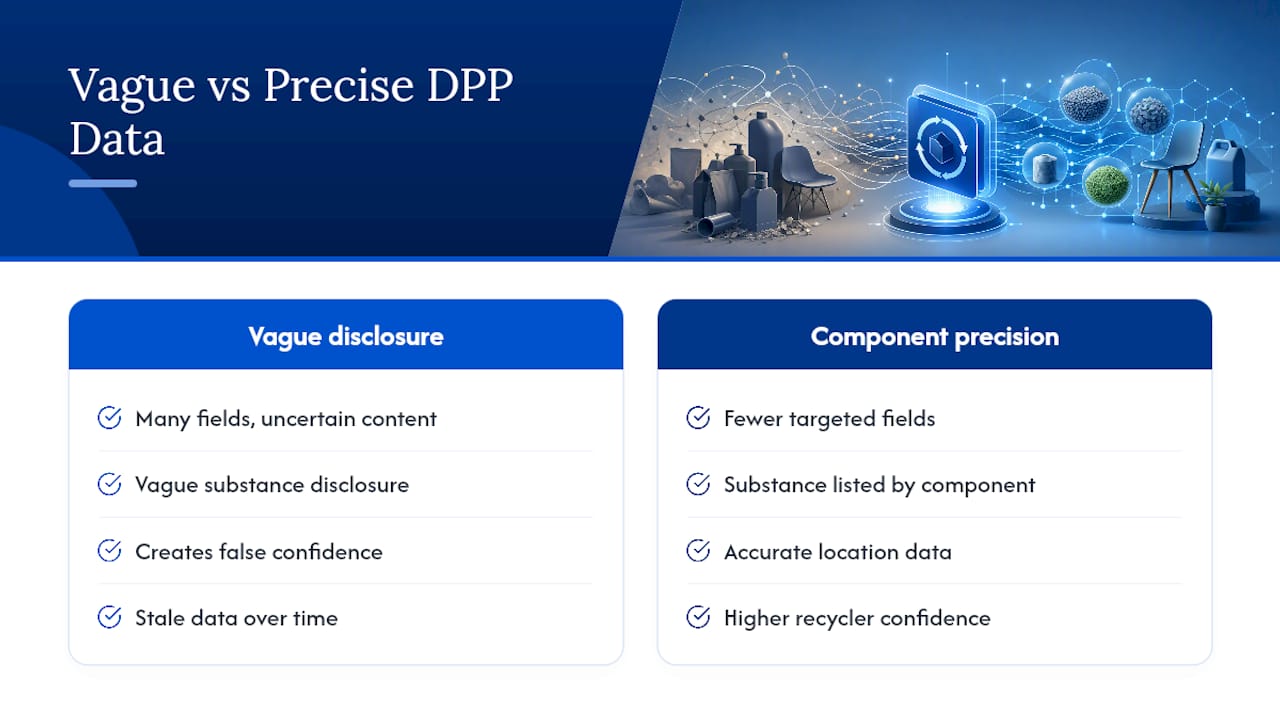
The conventional advice tells manufacturers to "capture recycling information" as though any structured data satisfies the goal. It doesn't. Vague substance disclosure ("contains chemicals of concern") is arguably worse than an honest gap, because it creates false confidence in downstream sorting decisions. The field that separates a genuinely useful passport from a box-ticking one is precision at the component level, not breadth of coverage.
If you're starting from scratch, resist the urge to build every field for every product simultaneously. Batteries, electronics, and blended-fiber textiles face the tightest scrutiny and the earliest delegated acts. Get those right first. The rest of your catalog can follow once your evidence-collection process is proven, not before.
Get Your Recycling Data Passport-Ready With DDP Grid
Building this dataset manually across spreadsheets, supplier emails, and PDF certificates is where most compliance timelines quietly slip. DDP Grid replaces that scramble with a single workspace: import your product catalog from Shopify, CSV, or API, send suppliers a structured questionnaire instead of a vague email request, and let AI-assisted extraction pull candidate values from uploaded certificates while a human reviewer signs off before anything publishes.

The platform is built for independent fashion brands, Shopify merchants, and manufacturers selling into the UK and EU who need a working evidence trail behind their recycling claims, not just a filled-in template. You get model and batch-level granularity, QR-coded passport pages, and role-based access so recyclers see what they need without exposing commercial data. If you're mapping your first recycling dataset against ESPR requirements, start with the DPP Grid platform overview to see how the import and evidence workflow fits your product catalog, or check the UK compliance guide if you're selling across both markets.
What Is a Digital Product Passport?
A Digital Product Passport is a structured, machine-readable dataset tied to a specific product, model, or batch, containing information such as material composition, recycled content, substances of concern, and end-of-life handling instructions, accessed through a data carrier like a QR code or RFID tag.
What Recycling Fields Are Mandatory for a DPP?
The core set includes material composition by component, recycled content percentage with provenance, substance-of-concern identification with exact location, disassembly instructions, and end-of-life handling guidance, though the exact list depends on the product-specific delegated act that applies to your category.
Who Can Access Recycling Data in a DPP?
Circularity and end-of-life guidance are generally accessible to recyclers and repairers, while commercially sensitive fields like supplier pricing are typically restricted through scoped API access or authenticated queries.
How Do You Prove Recycled Content Percentage?
Recycled content claims need supporting evidence such as supplier chain-of-custody certificates and batch-specific test reports, linked directly inside the passport rather than referenced separately, since accuracy and completeness are legal requirements under the ESPR.
Can DPP Grid Make My Product Legally Compliant?
DPP Grid provides the data infrastructure, supplier evidence collection, and publishing tools to help you organize and demonstrate recycling information, but it does not issue legal certification, so manufacturers should confirm delegated-act requirements with legal counsel.