
Overview
TL;DR:
- Resale as a service enables brands to run their own resale channels while ensuring item-level Digital Product Passports remain continuous through ownership transfers. Maintaining passport accuracy during resale supports compliance, authenticity, and revenue recovery in Central Europe. Implementing DPP infrastructure early ensures seamless tracking, regulatory readiness, and enhances brand control over the resale process.
Resale as a service (RaaS) is a SaaS-delivered model where a brand runs its own resale channel while keeping item-level Digital Product Passports intact across every ownership transfer. For fashion and consumer-product brands selling into Central Europe, that second half of the definition is no longer optional. Under ESPR and GPSR, the passport must remain accurate and accessible throughout a product's life, including after resale.
The short version:
- RaaS without DPP continuity creates audit gaps that market surveillance authorities can act on.
- Brand-controlled resale outperforms generic marketplaces on compliance, authenticity, and recovered revenue.
- The minimum viable stack: item-level identifiers, ownership-transfer records, audit trail, QR access, and Shopify or API integration.
- Recommended pilot option: DPP Grid supports all of the above and can be tested before committing to a full rollout.
Table of Contents
- What does resale as a service actually mean for your brand?
- How does resale connect to the Digital Product Passport under ESPR and GPSR?
- Which technical features should you evaluate in a resale-as-a-service SaaS?
- How do you implement DPP-enabled resale in Central Europe?
- Brand-controlled resale versus third-party marketplaces: what are the real tradeoffs?
- What KPIs should you track for compliance and circularity reporting?
- How does DPP Grid support resale-as-a-service for Central Europe brands?
- How do you run a pilot in 4–8 weeks?
- Key Takeaways
- Why integrated DPP and resale infrastructure is the only approach worth building
- Start your DPP-enabled resale pilot with DPP Grid
- Useful sources
- FAQ
What does resale as a service actually mean for your brand?
Operationally, RaaS means your brand owns the resale channel through a SaaS platform rather than routing pre-owned inventory through open marketplaces. The platform handles grading, pricing logic, logistics coordination, consumer UX, and passport updates. Your team keeps control of the data.
The business case in Central Europe is straightforward. Brand-controlled resale recovers revenue from returns and end-of-season stock, reduces counterfeit risk, and gives you the circularity data regulators increasingly expect. Generic marketplaces do none of that cleanly: they break the chain of custody, fragment your product data, and hand your customer relationship to a third party.
Core benefits for decision makers:
- Compliance support: ownership transfers logged against the DPP, not lost in a marketplace transaction.
- Fraud reduction: item-level authenticity checks tied to the original passport record.
- Brand equity: the resale experience stays inside your visual identity and customer journey.
- Recovered revenue: brands using structured resale programs report meaningful uplift in customer lifetime value compared to liquidation channels.
- Circularity reporting: resale event data feeds directly into ESPR-relevant metrics.
Pro Tip: Start with your highest-return SKUs. Piloting RaaS on a narrow, high-volume category gives you clean data for the circularity report before you scale.

How does resale connect to the Digital Product Passport under ESPR and GPSR?
The Digital Product Passport is a machine-readable product identity that stores sustainability and lifecycle data, accessible via a data carrier such as a QR code or GS1 Digital Link. The economic operator or an appointed DPP service provider hosts the full passport content. The EU Registry, required to be operational by 19 July 2026 under ESPR Article 13, functions as an index, not a data store. Your brand remains responsible for keeping the hosted passport accurate.
ESPR entered into force in 2024, with product-group-specific obligations set through delegated acts. First delegated acts are expected in early 2027. That timeline matters: brands that build configurable DPP infrastructure now avoid costly rework when their product group's delegated acts land.
For resale specifically, the practical implication is this: when a product changes hands, the passport must reflect that event. A resale transaction that leaves the DPP unchanged is an incomplete record. Market surveillance authorities checking a product in a Central European warehouse will look for a consistent, timestamped ownership history.
Must-have capabilities for compliance:
- Item-level unique identifiers (not model-only)
- Audit trail with version history and timestamps
- Ownership-transfer events recorded as discrete, signed entries
- Evidence attachments (bill of sale, transfer confirmation)
- Machine-readable export for market surveillance
- Access controls separating public, supplier, and authority views
| Capability | Why it matters for resale compliance |
|---|---|
| Item-level identifier | Links each physical unit to its passport across ownership changes |
| Audit trail / version history | Provides the timestamped record regulators inspect |
| Ownership-transfer logging | Satisfies the DPP continuity requirement under ESPR Article 11 |
| Evidence attachments | Supports authenticity and condition claims at resale |
| Machine-readable export | Enables market surveillance access without manual extraction |
Which technical features should you evaluate in a resale-as-a-service SaaS?
Product granularity is the first filter. Model-level passports are insufficient for resale: two units of the same model may have different condition histories, repair records, or ownership chains. Item-level or serial-level identifiers are the only approach that holds up under audit.
After granularity, evaluate these capability areas:
Data and evidence management
- Supplier evidence capture with document attachments
- AI-assisted data extraction with a mandatory human-review gate before publishing
- Version history so every change is traceable
Integrations
- Shopify integration for ecommerce-native brands
- API and CSV import for brands with existing ERP or WMS systems
- QR code and GS1 Digital Link generation tied to item-level records
Consumer UX
- No-app QR scan for immediate passport access
- Digital wardrobe for consumers to save and manage owned items
- Ownership registration and transfer flow built into the consumer interface
Operational services
- Grading and condition-scoring workflows for B-stock and returns
- Repair and care content publishing linked to the passport
- ESPR/GPSR reporting exports
| Dimension | What to look for |
|---|---|
| Product granularity | Item/serial-level support, not model-only |
| Ownership transfer | API-accessible transfer events with evidence capture |
| Evidence management | Document attachments, audit trail, versioning |
| Integrations | Shopify native, API, CSV |
| Consumer UX | No-app QR, digital wardrobe, ownership registration |
| Regulatory readiness | Machine-readable records, ESPR/GPSR report exports |
| Data sovereignty | Hosting options, backup copy arrangements |
| Pricing model | Subscription tiers by SKU count or identifier volume |
How do you implement DPP-enabled resale in Central Europe?
A realistic rollout runs 6–10 weeks from data mapping to first live passport. Here is the sequence:
- Data mapping (weeks 1–2): Inventory your product data fields, identify gaps, assign internal owners and supplier sources for each field.
- Identifier strategy (week 2): Decide on item-level or batch-level identifiers. Item-level is more future-proof for fashion.
- Supplier evidence collection (weeks 2–4): Gather material composition documents, conformity records, and manufacturing data. Attach to draft passports.
- Platform integration (weeks 3–5): Connect via Shopify, API, or CSV. Generate QR codes and data carriers for your first SKU batch.
- Human review and publish (weeks 4–6): Review AI-extracted data, approve, and publish passport pages.
- Consumer UX activation (week 6): Enable digital wardrobe, ownership registration, and resale infrastructure.
- Reporting setup (weeks 7–10): Configure ESPR/GPSR metric exports, verify audit trail completeness, and set update triggers for resale events.
| Phase | Key milestone | Typical duration |
|---|---|---|
| Data mapping | Field inventory complete | 1–2 weeks |
| Integration | First SKU batch imported | 2–3 weeks |
| Publishing | First passports live with QR | 4–6 weeks |
| Resale activation | Ownership transfer flow live | 6–8 weeks |
| Reporting | First compliance export generated | 8–10 weeks |
Brand-controlled resale versus third-party marketplaces: what are the real tradeoffs?
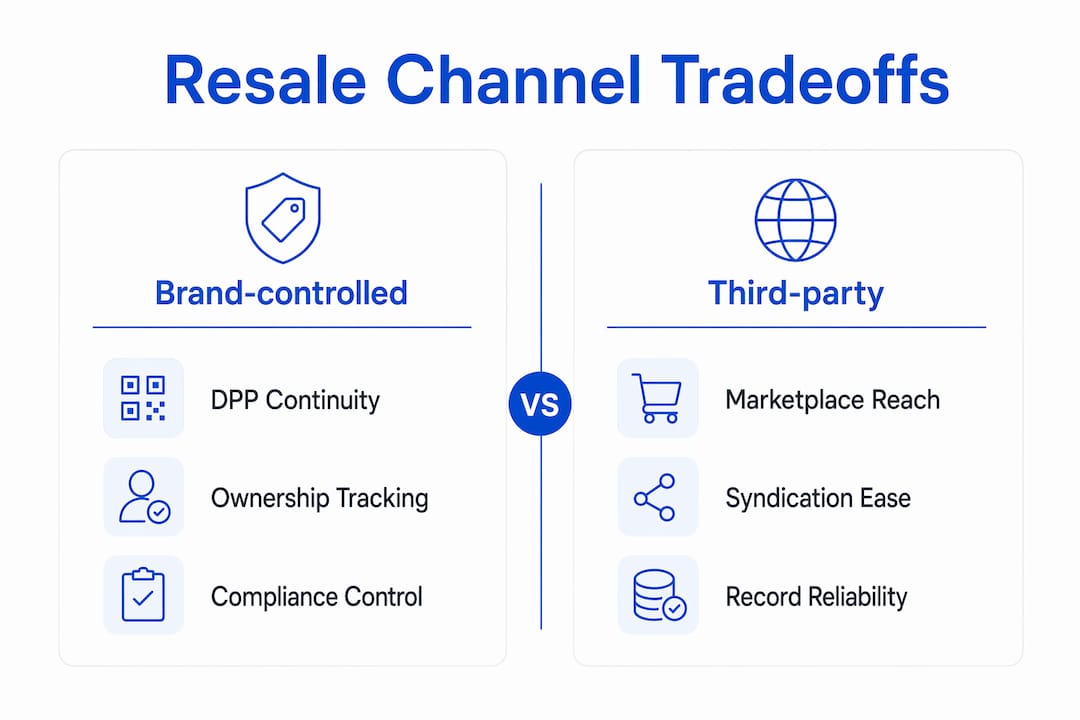
The compliance argument for brand-controlled resale is clear. When a product sells through an open marketplace, the ownership-transfer event typically goes unrecorded in your DPP. That breaks the audit trail ESPR Article 11 requires. You also lose visibility into condition, location, and the consumer relationship.
Pro Tip: A hybrid approach works for many brands: maintain the master DPP record internally, then syndicate listings to marketplaces for reach. The passport stays yours; the marketplace just drives traffic.
| Factor | Brand-controlled resale | Third-party marketplace |
|---|---|---|
| DPP continuity | Maintained, ownership transfer logged | Typically broken, no transfer record |
| Authenticity control | Item-level verification possible | Dependent on marketplace policy |
| Customer experience | Brand-consistent | Marketplace-branded |
| Revenue capture | Higher margin, direct settlement | Commission-heavy, less control |
| Compliance exposure | Lower, audit trail intact | Higher, data gaps likely |
| Setup effort | Higher upfront | Lower upfront, higher long-term risk |
Practical mitigations if you use marketplaces alongside brand-controlled resale: require marketplace partners to pass item identifiers back to your system, log the transfer event manually or via API, and treat the marketplace as a distribution channel, not a data owner.
Pro Tip: Never let a marketplace become your system of record for product history. Even if a sale happens there, the DPP update must happen in your platform.
What KPIs should you track for compliance and circularity reporting?
Regulators and internal stakeholders need different views of the same data. Build your reporting stack around these metrics from the start.
Essential KPIs:
- Share of active SKUs with item-level DPP (target: 100% before delegated act deadline)
- Percentage of resold items with a verified ownership-transfer record
- Evidence-attachment completion rate per product category
- Time-to-publish: days from product creation to live passport
- Recovered revenue per SKU from resale channel
| Report type | Primary audience | Key data points |
|---|---|---|
| DPP registration count | Legal / compliance | SKUs registered, registry URI status |
| Audit trail export | Market surveillance | Transfer events, timestamps, evidence links |
| Evidence completion log | Operations | Fields complete vs. required, gap list |
| Circularity summary | Sustainability / CFO | Resale volume, recovered revenue, items extended |
| GPSR readiness report | Legal | Safety information completeness, economic operator data |
Repair and care data published in the passport also feeds circularity KPIs. When a consumer accesses repair guidance through the QR code and extends a product's life, that event is trackable and reportable.
How does DPP Grid support resale-as-a-service for Central Europe brands?
DPP Grid provides the product-data infrastructure that makes DPP-enabled resale operational. Brands import products via Shopify, CSV, or API, collect supplier evidence, use AI-assisted extraction with a human-review gate, and publish permanent passport pages with QR codes that resolve without requiring consumers to install an app.
At the item level, DPP Grid supports ownership registration, transfer workflows, and audit trails with version history. Every ownership-transfer event is recorded as a discrete entry with timestamp and supporting evidence. That record is exportable for market surveillance.
DPP Grid provides product-data infrastructure, evidence management, readiness workflows, and publication tools. It does not provide legal certification and does not claim that using the platform automatically makes a product compliant.
The platform maps directly to the evaluation dimensions that matter for resale:
- Product granularity: model, batch, and item-level records supported
- Ownership transfer: consumer-facing registration and transfer flow, API-accessible events
- Evidence management: document attachments, audit trail, version history
- Integrations: Shopify native, API, CSV
- Consumer UX: no-app QR scan, digital wardrobe, ownership registration
- Regulatory readiness: machine-readable records, EU DPP Registry readiness workflows
DPP Grid does not handle physical logistics, grading, or warehousing. For brands that need end-to-end operational resale services alongside DPP infrastructure, the platform is designed to work alongside operational partners.
How do you run a pilot in 4–8 weeks?
Before signing a contract, ask any vendor these questions:
- Does the platform support item-level identifiers, or only model-level?
- How are ownership-transfer events recorded and exported?
- What evidence formats does the platform accept for document attachments?
- Where is data hosted, and what are the backup-copy arrangements?
- How long does Shopify or CSV onboarding take, and what support is included?
- What is the SLA for passport availability and audit-log access?
Pilot scope for a Central Europe brand:
- 500 SKUs or one store market
- Sample supplier evidence set covering material composition and conformity documents
- Defined acceptance criteria: passport accuracy rate, transfer-log completeness, time-to-publish
Pilot success criteria:
- Item-level DPP creation rate above your defined threshold
- Ownership-transfer records generated for every test resale transaction
- Compliance report exportable within the pilot window
- Consumer QR access confirmed without app installation
Key Takeaways
Resale as a service only delivers compliance value when item-level DPP continuity is maintained across every ownership transfer — brands that skip that requirement face audit gaps under ESPR Article 11.
| Point | Details |
|---|---|
| Item-level identifiers are essential | Model-only passports do not support ownership tracking or authenticity verification at resale. |
| ESPR Registry deadline is mid-2026 | The Commission aims to have the Registry operational by 19 July 2026; brands are advised to prepare DPP infrastructure before then. |
| Brand-controlled resale protects audit trails | Third-party marketplaces often disrupt DPP continuity; brand-owned channels maintain transfer records. |
| Pilot scope: a focused SKU range over weeks | A narrow pilot with clear criteria validates the system before full rollout. |
| DPP Grid as a recommended pilot option | DPP Grid supports item-level passports, ownership transfer, audit trails, Shopify integration, and QR publishing for Central Europe brands. |
Why integrated DPP and resale infrastructure is the only approach worth building
The brands I see getting this wrong share one pattern: they treat resale as a commercial add-on and DPP compliance as a separate legal workstream. Those two tracks eventually collide, usually during a market surveillance inspection or when a delegated act lands and the data architecture needs rebuilding from scratch.
The smarter move is to treat the DPP as the operating system for the product's entire life, including resale. When ownership transfer is a logged event on the passport, authenticity is verifiable, circularity metrics are real, and the audit trail is already there when someone asks for it. That is not a compliance cost. It is the infrastructure that makes resale commercially defensible.
The common mistake is launching resale first and trying to retrofit DPP continuity later. The identifier strategy, the evidence collection, the transfer workflow: these need to be designed before the first item is listed, not after the first audit question arrives.
Start your DPP-enabled resale pilot with DPP Grid
Fashion and consumer-product brands in Central Europe that need item-level DPP infrastructure alongside a resale channel have a concrete starting point. DPP Grid gives you permanent passport pages, QR publishing, ownership-transfer records, audit trails, and Shopify integration in one platform, with a 14-day free trial before any commitment.

Onboarding typically runs within days, not months. The platform's data-mapping support and AI-assisted extraction mean your team is not starting from a blank spreadsheet. Start your pilot on DPP Grid and see how far you can get in two weeks with your existing product data.
This article is general information, not legal advice. Confirm your specific obligations under ESPR and GPSR with a qualified legal professional or the relevant regulatory authority.
Useful sources
EU regulatory references:
- ESPR Regulation (EU) 2024/1781 consolidated text: the primary legal text covering DPP framework, Registry, and Article 11 continuity requirements. Essential for legal and compliance teams.
- European Commission DPP overview: explains the DPP concept, data-carrier requirements, and hosting responsibilities. Starting point for procurement teams.
- ESPR delegated-act framework summary: explains how product-group-specific obligations are set and when first delegated acts are expected. Useful for planning timelines.
DPP Grid documentation:
| Resource | What it covers | Who needs it |
|---|---|---|
| DPP Grid product platform | Item-level passports, integrations, AI extraction | Procurement, technical teams |
| Authenticity and resale infrastructure | Ownership transfer, QR access, resale workflows | Operations, legal |
| EU DPP Registry readiness | Registry interaction and compliance planning | Legal, compliance |
| Product passport QR codes | QR publishing and consumer access | Technical, UX teams |
| Repair and care publishing | Linking repair data to passports for circularity | Sustainability, operations |
What is resale as a service for fashion brands?
Resale as a service (RaaS) is a SaaS model where a brand runs its own resale channel through a platform that handles operations, consumer UX, and product-passport continuity, rather than routing pre-owned inventory through open marketplaces.
Does the Digital Product Passport need to be updated when a product is resold?
Yes. Under ESPR Article 11, the passport must remain accurate throughout the product's life. An ownership transfer is a lifecycle event that should be recorded in the DPP to maintain a complete, auditable history.
When does the EU DPP Registry need to be operational?
The ESPR consolidated text requires the Commission to have the Registry operational by 19 July 2026. Product-group-specific DPP obligations are set through delegated acts, with first acts expected in early 2027.
Does DPP Grid handle physical resale logistics?
No. DPP Grid provides product-data infrastructure, passport publishing, ownership-transfer records, and integrations. Physical grading, warehousing, and logistics are handled by operational partners alongside the platform.
How long does it take to pilot DPP-enabled resale with DPP Grid?
A focused pilot covering around 500 SKUs typically runs 4–8 weeks from onboarding to first live passports with ownership-transfer capability, depending on the completeness of your existing product data.