
Overview
Electronics makers and importers can't get certified for a rule that hasn't fully published its technical detail yet, but they can stop waiting. The near-term reality: delegated acts covering electronics under the Ecodesign for Sustainable Products Regulation are expected between 2027 and 2029, with mandatory application typically landing about 18 months after adoption. Start now on three fronts: map product identifiers and supplier evidence, decide whether you need item, batch, or model level passports, and pick a hosting and publishing workflow before the deadline forces a rushed one.
TL;DR:
- Electronics manufacturers should start mapping product identifiers and supplier evidence now to prepare for mandatory digital passports expected between 2027 and 2029.
- Passports will require specific data fields such as unique identifiers, raw material information, reparability details, software support periods, and recycling instructions, all backed by verified evidence.
- Implementing the passports at the item, batch, or model level depends on product complexity and ownership transfer needs; item-level tracking is most flexible but costliest.
- Using open, machine-readable formats like QR codes or APIs linked to a central registry ensures compliance and facilitates inspector and repairer access.
- Early pilot testing, mapping evidence gaps, and choosing appropriate hosting and governance practices can prevent costly last-minute compliance efforts once delegated acts are finalized.
Table of Contents
- What Is an Electronics Digital Product Passport?
- When Will Electronics Need a Digital Product Passport?
- What Data Fields and Evidence Do Electronics Passports Need?
- How Do You Actually Implement This? A Practical Checklist
- What Standards and Registries Should You Trust?
- What Manufacturers Get Wrong About Digital Passports
- How DPP Grid Helps You Get Passports Ready and Published
- Sources
- FAQ
What Is an Electronics Digital Product Passport?
A Digital Product Passport is a structured, product-specific dataset, accessible through a physical data carrier, that documents a product's materials, origin, and lifecycle information. ESPR defines it this way and requires that the data use open, machine-readable formats, carry unique identifiers, and follow regulated access rights so different users see different fields. For electronics, the passport isn't a marketing sheet. It's a compliance record meant to survive audits, recalls, and resale.
The level you choose changes what the passport can do:
- Model-level passports work for standardized products where every unit is functionally identical, such as a mass-produced charger.
- Batch-level passports matter when a recall or defect might affect one production run but not another, common with battery cells.
- Item-level passports track a single unit through repairs, ownership changes, and resale, which matters for premium devices with real secondhand value.
Access needs differ by user too. Manufacturers need full visibility for compliance filings; repairers need disassembly and parts data; recyclers need material composition; market surveillance authorities need the whole record; consumers typically see a simplified public view.
When Will Electronics Need a Digital Product Passport?
ESPR itself is a framework law. It doesn't mandate DPPs for any specific product category on its own; that job belongs to delegated acts, adopted product group by product group under the Commission's working plan. Electronics and ICT sit near the front of that queue, and industry timelines put initial delegated-act activity and technical standard publication in the 2026-2028 window, followed by roughly 18 months before mandatory application kicks in.
Turn that into a planning calendar with three phases:
- Pilot now. Pick one or two product lines, build a passport structure, and stress-test it against your actual supplier data gaps.
- Collect through 2027. Use the delegated-act adoption window to gather evidence you do not yet have, especially from second- and third-tier suppliers.
- Publish before enforcement. Aim to have live passports on priority lines well before the 18-month clock on any adopted act runs out, not the week it does.
Existing measures already require some of this. Regulation (EU) 2023/1670 on mobile phones and tablets requires disclosures on durability and repairability that a DPP will likely absorb and expand rather than replace, so a smartphone or tablet maker isn't starting from zero.
What Data Fields and Evidence Do Electronics Passports Need?
Sector guidance points to a consistent set of fields likely to become required once delegated acts land, drawn from what ESPR's sector guidance already flags as priority categories for electronics:
- Unique product identifier and manufacturer/final assembly location
- Critical raw materials and substances of concern under REACH and RoHS
- Reparability and disassembly guidance, including spare-parts availability
- Software-support duration and end-of-support commitments
- Energy consumption and efficiency metrics
- Recycled content percentages
- End-of-life disposal and recycling instructions
Pro Tip: Don't wait for the final field list to start collecting evidence. A bill of materials, a REACH declaration, or a repair manual you gather today for one product line becomes the template for every SKU you onboard after the delegated act lands.
Each field needs a specific evidence type behind it, not a claim. A reparability score needs disassembly test documentation. A substances-of-concern field needs supplier declarations, not an assumption that your components are compliant. Software-support duration needs an actual internal roadmap commitment, something legal and product teams should align on before it's published, not after.
On the technical side, ESPR requires open, machine-readable formats. In practice that means a QR code following GS1 Digital Link conventions, NFC tags for higher-value items, or an API conforming to the emerging EN 1821x family of standards. The data carrier is just the pointer; the actual record lives in a registry or with a hosting provider, and it has to stay accessible for the product's expected lifetime, not just at the point of sale.
How Do You Actually Implement This? A Practical Checklist
Most electronics manufacturers already have fragments of this data scattered across ERP systems, supplier emails, and PDF spec sheets. The work is consolidation, not invention.
- Pick pilot SKUs. Start with batteries, peripherals, or any product line already facing scrutiny under existing Ecodesign rules. Decide item, batch, or model level for each before you touch a spreadsheet.
- Map what you already have. Pull existing compliance documents, test reports, and bills of materials, then flag which required fields have no current evidence source.
- Request supplier documentation for the gaps. This is almost always the slowest step. Give suppliers a fixed template so you're not reconciling five different formats later.
- Choose a publishing approach. Self-hosting means building and maintaining your own registry connection and data carrier generation. A dedicated DPP service provider handles that infrastructure so your team focuses on the data itself. Either way, confirm your import paths, whether that's Shopify, CSV, or API, generate persistent URIs, and print QR codes that won't need reissuing every time a field updates.
- Set governance before launch. Assign who can edit which fields, define an access-rights matrix for repairers versus consumers versus regulators, and keep an audit trail of every evidence update.
- Run a market-surveillance dry run. Pretend an inspector asked for the full record on one pilot product. If your team can't produce it in under an hour, your evidence tagging needs work.
Design guidance from CEN-CENELEC's 2025 workshop agreement is worth reading before you lock in item versus batch versus model. Item-level tracking is the most flexible but also the most expensive to maintain. It earns its cost mainly where ownership transfers or lifecycle events, like a battery swap, actually matter to the product's story.
What Standards and Registries Should You Trust?
Commission Implementing Decision (EU) 2026/1736 references the harmonised EN 18216 through EN 18223 series, covering data exchange formats, identifier schemes, data carrier specifications, storage requirements, API structures, and cross-platform interoperability. Following these standards gives you a presumption of conformity under ESPR, meaning inspectors treat compliant technical design as meeting the legal requirement rather than something you have to argue case by case.
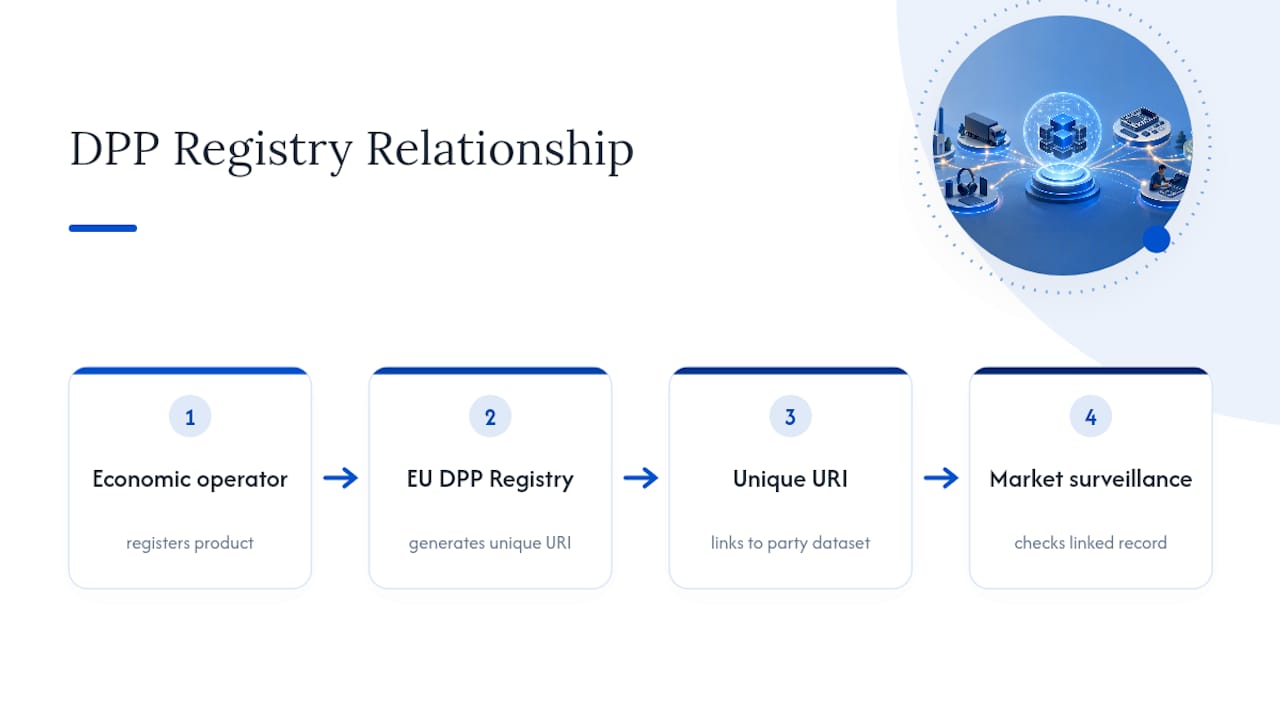
The EU's central DPP Registry is where registration actually happens. An economic operator registers a product, the registry generates a unique URI, and that URI ties back to whichever party, the manufacturer or a hosting provider, holds the full dataset. Market surveillance authorities check against this registry directly, so a passport that exists only on your website without registry linkage won't hold up.
What Manufacturers Get Wrong About Digital Passports
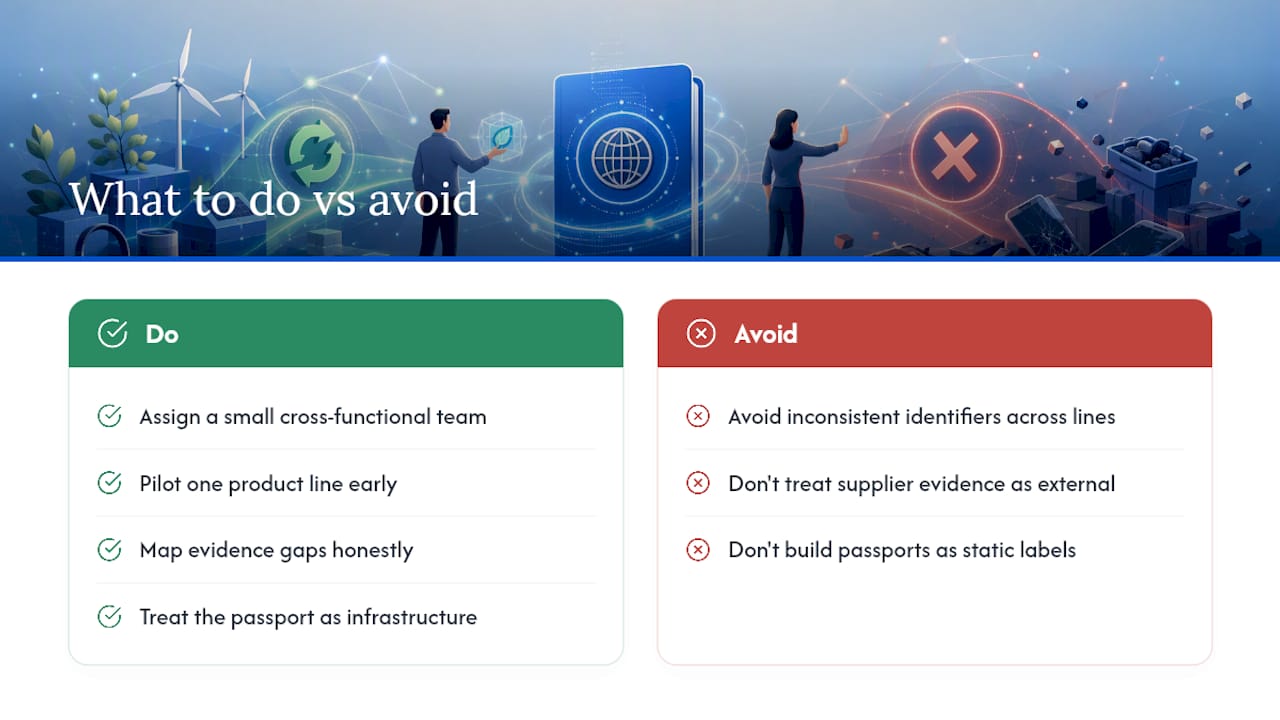
The most common mistake isn't missing data. It's inconsistent identifiers across product lines, built by different teams at different times with no shared naming logic. The second is treating supplier evidence as someone else's problem until an inspector asks for it. The third, and the costliest, is building a passport as a static label instead of a living record that needs version control and update ownership.
Give this to a small team, not one person: a product data lead who owns the schema, a compliance manager who signs off on what counts as evidence, and a supplier liaison who chases documentation before it becomes a bottleneck. Manufacturers who pilot one product line early, map their evidence gaps honestly, and treat the passport as infrastructure rather than paperwork consistently avoid the expensive scramble that hits everyone else once a delegated act's clock actually starts.
— Vytautas
How DPP Grid Helps You Get Passports Ready and Published
There are platforms that help electronics manufacturers and importers avoid building this infrastructure from scratch by enabling product import from Shopify, CSV, or API, collecting supplier documentation through structured requests, and using AI-assisted data extraction with human review before publication.

Some platforms support model, batch, and item-level passports, so different product lines can run different structures within the same account. Once evidence is tagged and approved, these platforms publish persistent passport pages with QR codes and machine-readable records, similar to registry-linked data carriers that inspectors and repairers expect to scan. This fits naturally into the checklist above: centralize the data, version the evidence, publish the carrier.
DPP Grid doesn't provide legal certification and doesn't claim that using the platform makes a product automatically compliant. It's product-data infrastructure and readiness tooling. For formal conformity assessments, you'll still need qualified legal or regulatory review. If you're ready to see how the platform's capabilities map onto your own product catalog, start with a pilot SKU and a free trial.
Sources
What Products Need a Digital Product Passport?
No electronics category has a mandatory DPP requirement yet as of 2026; delegated acts under ESPR are expected for electronics and ICT between 2027 and 2029, with textiles, furniture, and batteries also on the Commission's priority list.
Does the UK Have Its Own Digital Product Passport?
The UK is not bound by ESPR since it's an EU regulation, but any manufacturer or importer selling electronics into the EU market still needs to meet EU DPP requirements for those products regardless of where the company is based.
Can You Give an Example of a Digital Product Passport Entry?
A typical electronics passport entry might list a unique product ID, the assembly location, a bill of materials flagging critical raw materials, a repairability score with disassembly instructions, and a software-support end date, all linked from a QR code on the device.
What Electronics Data Fields Actually Go Into a Passport?
Expected fields include the unique identifier, manufacturer and assembly details, substances of concern under REACH and RoHS, reparability and disassembly guidance, software-support duration, energy metrics, recycled content, and end-of-life disposal instructions.